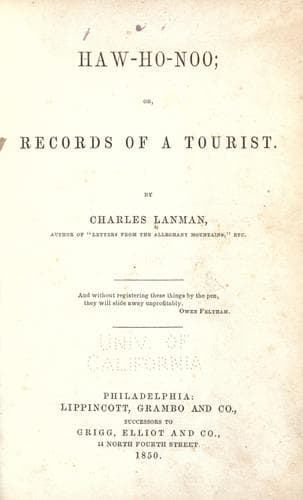
Haw-Ho-Noo; Or, Records of a TouristLanman, Charles
History
Haw-Ho-Noo; Or, Records of a Tourist
Lanman, Charles
Fishing -- North America; United States -- Description and travel
Never has Lilly Larnard been more than thirty miles away from the
village of her birth. She has read of cities, and the busy multitudes
that throng them; of armies and navies; of politics and war; but all
these things to her are but as the visions of a dream. She is ignorant
of the real condition and character of the great world, for naught but
the echo of its din has ever fallen upon her ear. She listens with
wonder to the deeds of which we sometimes tell her we have been an
unwilling witness in the wilderness of men. She thinks it strange, that
the inhabitants of cities think so much of the present life, and so
little of the future. Her days have been spent in innocence beneath the
blue dome of the illimitable sky, inhaling the pure unadulterated air of
the country, now sporting in the sunshine, and now sprinkled by a
refreshing shower; while the loveliest of flowers and birds, and holy
and tender affections, have been her hourly companions; and her nights
have passed away in pleasant dreams of that bright world beyond the
stars.
BASSE FISHING.
“We delight, as all the world has long well known, in every kind of
fishing, from the whale to the minnow.”
Christopher North.
The beautiful fish now chosen for our “subject theme” is a genuine
_native American_, and ranks high among the game fish of the country.
When fully grown, he is commonly about fifteen inches long, two inches
in thickness, and some five inches broad, weighing perhaps five or six
pounds. He belongs to the perch family, has a thick oval head, a swallow
tail, sharp teeth, and small scales. In color, he is deep black along
the back and sides, growing lighter and somewhat yellowish towards the
belly. He has a large mouth and is a bold biter, feeds upon minnows and
insects, is strong and active, and when in season possesses a fine
flavor. He spawns in the spring, recovers in July, and is in his prime
in September.
The black basse is peculiarly a Western fish, and is not known in any of
the rivers which connect immediately with the Atlantic Ocean. They are
found in great abundance in the upper Mississippi and its tributaries,
in all the great lakes excepting Superior, in the upper St. Lawrence, in
Lake Champlain and Lake George, and nearly all the smaller lakes of New
York. In portions of the last-named State they are called the Oswego
basse, in the southwest the black perch, and in the northwest, where
they are most abundant, the black basse. In nearly all the waters where
they abound has it been our good fortune to angle for the fish, and his
very name is associated with much of the most beautiful scenery in the
land. Our own experience, however, in basse fishing is chiefly
identified with Lake George, Lake Erie, Lake Michigan, and the upper
Mississippi, and to these waters alone is it our purpose to devote a few
paragraphs.
Public-domain text, read in full here on John Shaqi.
Reviews
Reviews
No reviews yet
Be the first to share your thoughts on this work.
Elsewhere in the archive
Join the Discussion
Join the discussion
Sign in to leave a comment or review.
Sign InorCreate an account