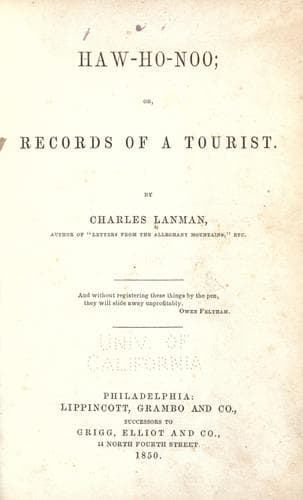
Haw-Ho-Noo; Or, Records of a TouristLanman, Charles
History
Haw-Ho-Noo; Or, Records of a Tourist
Lanman, Charles
Fishing -- North America; United States -- Description and travel
Like the trout, the black basse seems to be partial to the more romantic
and poetical places in the rivers which they frequent. On the river
Raisin, for example, we used to enjoy the rarest of sport at an old and
partly dilapidated mill-dam, which was covered with moss, and at the
foot of which were some of the nicest “deep holes” imaginable. Wherever
the timbers of the dam formed a “loop-hole of retreat,” there we were
always sure of finding a basse. And we also remember an old mill, in
whose shadowy recesses, far down among the foundation timbers, the basse
delighted to congregate, and where we were wont to spend many of our
Saturday afternoons; but our favorite expeditions were those which
occupied entire days, and led us along the banks of the Raisin, in the
vicinity of its mouth, and far beyond the hearing of the mill-wheel or
the clink of the blacksmith’s anvil. At such times the discovery of old
sunken logs was all that we cared for, for we knew that the basse
delighted to spend the noontide hours in their shadow. And when we could
borrow a canoe, and obtain a foothold on the extreme point of a wooded
island, so as to angle in the deep and dark holes, we seldom failed in
realizing all the enjoyment that we anticipated. And, if we chanced to
come across a party of fishermen drawing the seine, we were sure to
forget our promise to our parents to return home before sundown, and,
far too often for a good boy, did we remain with them even until the
moon had taken her station in the sky. To count the fish thus captured,
and to hear the strange adventures and exploits talked over by these
fishermen, was indeed a delightful species of vagabondizing; and we
usually avoided a very severe scolding by returning home “with one of
the largest basse ever caught in the river,” which we may have taken
with the hook or purchased of the fishermen. But we are talking of the
“times of the days of old,” and as we remember that the glories of the
River Raisin, in regard to its scenery and its fish, are for ever
departed, we hasten to other waters.
In fancy we have now crossed the peninsula of Michigan, or rather
compassed it by means of the splendid steamers which navigate the waters
of Huron and Michigan, and we are now on the banks of the river St.
Joseph. This is a small river, and unquestionably one of the most
beautiful in the western world. It runs through an exceedingly fertile
country, abounds in luxuriant islands, is invariably as clear as
crystal, and in its course winding to an uncommon degree. It is
navigable for small steamboats to the village of Niles, fifty miles from
its mouth, and for batteaux somewhere about fifty miles further, towards
its source. Early in the spring it abounds in the more common varieties
of fresh-water fish, but throughout the summer and autumn it yields the
black basse in the greatest abundance.
Public-domain text, read in full here on John Shaqi.
Reviews
Reviews
No reviews yet
Be the first to share your thoughts on this work.
Elsewhere in the archive
Join the Discussion
Join the discussion
Sign in to leave a comment or review.
Sign InorCreate an account