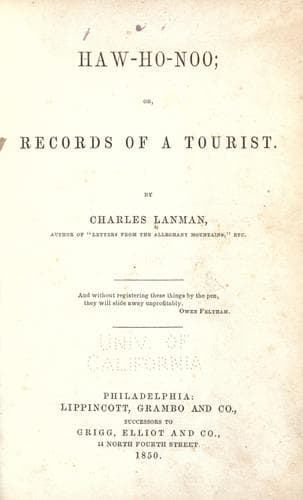
Haw-Ho-Noo; Or, Records of a TouristLanman, Charles
History
Haw-Ho-Noo; Or, Records of a Tourist
Lanman, Charles
Fishing -- North America; United States -- Description and travel
The rattlesnake derives its name from an instrument attached to its
tail, consisting of a series of hollow scaly pieces which, when shaken,
make a rattling or rustling noise. The number of these pieces or rattles
are said to correspond with the number of years which the animal has
attained, and some travelers assert that they have been discovered with
thirty rattles, though thirteen is a much more common number. It is one
of the most venomous of serpents, and yet one that we cannot but
respect, since it habitually makes the most honorable use of the
singular appendage with which it is gifted. It never strikes a foe
without first warning him of his danger. In form it is somewhat
corpulent, has a flat heart-shaped head, and is supplied with fangs,
varying from a half-inch to an inch in length, which lie hidden
horizontally in the flesh of the upper jaw, and are capable of being
thrown out like the blade of a knife. The venom emitted by it is so
deadly that it has been known to cause the death of a human being in a
very few hours, and to destroy a dog or cat in less than twenty minutes,
and yet we have met with some half-dozen individuals in our travels who
have been bitten by the rattlesnake without being seriously injured.
Horses and cattle are known to become exceedingly terrified at its
appearance, and generally speaking, when bitten, die in a short time,
and yet we once saw a horse, which was only troubled in consequence of
its bite, by a disease resembling the scurvy. The hair dropped from the
skin of the quadruped, and he looked horribly if he did not feel so. As
to the effect of this poison upon hogs, it has frequently been proven to
be perfectly harmless, and we know it to be the custom in certain
portions of the country for farmers to employ their swine for the
express purpose of destroying the rattlesnakes infesting their land. The
effect of the rattlesnake’s bite upon itself is said to be generally
fatal. In regard to the antidote of this poison we are acquainted with
only one, which is the plant commonly called the rattlesnake weed. Both
the leaf and the root are employed, and applied internally as well as
externally. This plant grows to the height of six or eight inches, has
one stock and a leaf resembling in shape the head of the rattlesnake,
and is almost invariably found in those sections of the country where
the reptile abounds.
Public-domain text, read in full here on John Shaqi.
Reviews
Reviews
No reviews yet
Be the first to share your thoughts on this work.
Elsewhere in the archive
Join the Discussion
Join the discussion
Sign in to leave a comment or review.
Sign InorCreate an account