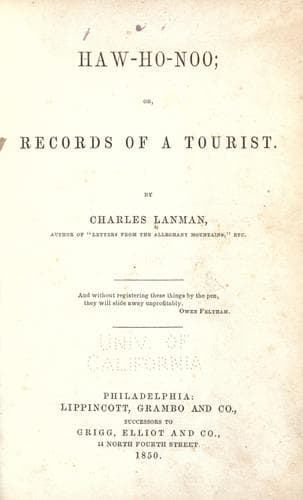
Haw-Ho-Noo; Or, Records of a TouristLanman, Charles
History
Haw-Ho-Noo; Or, Records of a Tourist
Lanman, Charles
Fishing -- North America; United States -- Description and travel
The rattlesnake is peculiar to the American continent. Four varieties
alone are known to naturalists, three of which are found in the United
States, and one in South America. In the States bordering on the Gulf of
Mexico they attain the length of seven and eight feet and a diameter of
three to four inches—the males having four fangs, and the females only
two. These are characterized by a kind of diamond figure on the skin,
and are partial to the low or bottom lands of the country. Those found
in the Middle and Northern States are called the common or banded
rattlesnakes, and are altogether the most abundant in the Union. They
vary in length from two and a half to four feet, and are partial to
mountainous and rocky districts. There is also a very small, but most
dangerous variety, called the ground rattlesnakes, which are found on
the sterile and sandy prairies of the West, and to a limited extent in
the barren districts of the South. In Canada they are almost unknown,
and even in the more thickly settled States of the Union they are
rapidly becoming extinct. As to their value, it may be stated that their
oil and gall are highly prized in all sections of the Union for
medicinal purposes, and by the Indians and slave population of the
South, their flesh is frequently employed as an article of food, and
really considered sweet and nourishing.
The attachment of the Aborigines to this famous reptile is proverbial:
among nearly all the tribes, even at the present day, it is seldom
disturbed, but is designated by the endearing epithet of _grandfather_.
It is recorded, however, by the early historians, that when one tribe
desired to challenge another to combat, they were in the habit of
sending into the midst of their enemy the skin of a rattlesnake, whereby
it would appear to have been employed as an emblem of revenge. And as to
the origin of the rattlesnake, the old men among the Cherokees relate a
legend to the following effect, which, the reader will notice, bears a
striking analogy to the history of our Saviour. A very beautiful young
man, with a white face and wrapped in a white robe, once made his
appearance in their nation, and commanded them to abandon all their old
customs and festivals, and to adopt a new religion. He made use of the
softest language, and everything that he did proved him to be a good
man. It so happened, however, that he could make no friends among them,
and the medicine men of the nation conspired to take away his life. In
many ways did they try to do this—by lashing him with serpents and by
giving him poison, but were always unsuccessful. But in process of time
the deed was accomplished and in the following manner. It was known that
the good stranger was in the habit of daily visiting a certain spring
for the purpose of quenching his thirst, and bathing his body. In view
of this fact, the magicians made a very beautiful war-club, inlaid with
bone and shells, and decorated with rattles, and this club they offered
Public-domain text, read in full here on John Shaqi.
Reviews
Reviews
No reviews yet
Be the first to share your thoughts on this work.
Elsewhere in the archive
Join the Discussion
Join the discussion
Sign in to leave a comment or review.
Sign InorCreate an account