"That as I've thanked God for all my life," she said, "He'll surely give
me in the end. He couldn't hold it back--I've so believed an' been
grateful to Him. If there hadn't been in you what would make a good man,
my dear, I couldn't have been so deceived an' so happy. No--not
deceived--that aint the word, Jem--the good was there. You've lived two
lives, may be,--but one was good, thank God! You've been a good son to
me. You've never hurt me, an' it was your love as hid from me the wrong
you did. You did love me, Jem--I won't give that up--never. There's
nothing you've done as can stand agen that, with her as is your mother.
You loved me an' was my own son--my boy as was a comfort an' a pride to
me from the first."
He watched her with a stunned look.
"You didn't believe _them_," he said hoarsely, "and you don't believe
_me_?"
She put her hand to her heart and almost smiled.
"It hasn't come home to me yet," she said. "I don't think it ever will."
He looked helplessly toward the pistol on the table. He knew it was all
over and he should not use it.
"What must I do?" he said, in the same hoarse voice.
"Get up," she said, "an' come with me. I'm a old woman but my heart's
strong, an' we've been poor before. We'll go away together an' leave it
all behind--all the sorrow of it an' the sin an' the shame. The life I
_thought_ you lived, my dear, is to be lived yet. Theer's places where
they wont know us an' where we can begin again. Get up and come with
me."
He scarcely grasped what she meant.
"With you!" he repeated. "You want me to go now?"
"Yes," she answered, "for Christ's sake, my dear, now."
He began to see the meaning and possibility of her simple, woman's plan,
and got up, ready to follow her. And then he found that the want of food
and the long day had worn upon him so that he was weak. She put her arm
beneath his and tried to support him.
"Lean on me, my dear," she said. "I'm stronger than you think."
They went out, leaving the empty room and the pistol on the table and
the dim light burning. And then they had locked the gate and were
outside with the few stars shining above and the great black Works
looming up before them.
He stopped a moment to look back and up and remembered the key. Suddenly
he raised it in his hand and flung it across the top of the locked
gate; they heard it fall inside upon the pavement with a clang.
"They'll wonder how it came there," he said. "They'll take down the name
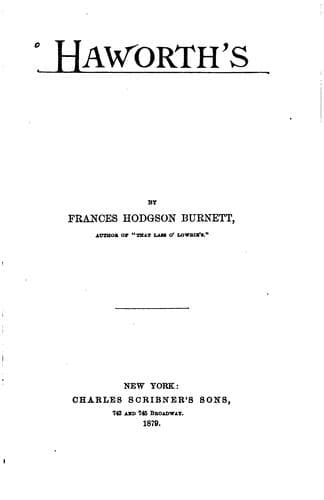
to-morrow. 'Haworth's' is done with!"
He turned to her and said, "Come." His voice was a little stronger. They
went down the lane together, and were lost in the darkness.
CHAPTER LIII.
"A BIT O' GOOD BLACK."
Granny Dixon was interred with pomp and ceremony, or, at least, with
what appeared pomp and ceremony in the eyes of the lower social stratum
of Broxton.
Public-domain text, read in full here on John Shaqi.
Reviews
Reviews
No reviews yet
Be the first to share your thoughts on this work.
Elsewhere in the archive
Join the Discussion
Join the discussion
Sign in to leave a comment or review.
Sign InorCreate an account