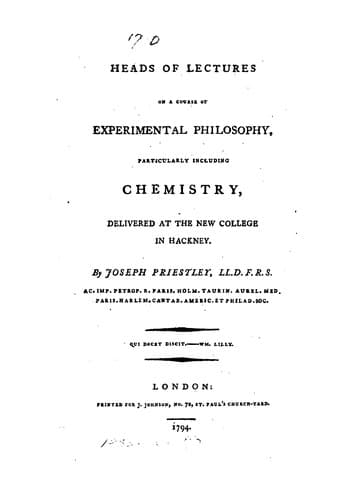
Heads of Lectures on a Course of Experimental Philosophy: Particularly Including Chemistry — John Shaqi
Heads of Lectures on a Course of Experimental Philosophy: Particularly Including ChemistryPriestley, Joseph
Philosophy
Heads of Lectures on a Course of Experimental Philosophy: Particularly Including Chemistry
Priestley, Joseph
Chemistry -- Early works to 1800
Tin precipitates gold in the form of a purple powder, called the _powder
of Cassius_, from the inventor of it, and is used in enamels, or the
glassy coating which is given to metals by heat.
Gold unites with most of the metals, especially with mercury, and these
mixtures are called _amalgams_. In gilding, the amalgam is applied to
the surface of the metal to be gilded, and the mercury is driven off by
heat, leaving the gold attached to the surface.
Gold mixed with iron, makes it harder, for the purpose of cutting
instruments.
To separate gold from the imperfect metals, such as copper, &c. it is
mixed with lead, and then exposed to a strong heat, which calcines the
lead, and with it the imperfect metals, leaving the gold pure. This
process is called _cupellation_, from being performed in a small
crucible called a _cupell_. When the gold is mixed with silver, three
parts more of silver are put to it, and then the silver is dissolved by
nitrous acid, leaving the gold pure. This process is called
_quartation_, from the gold being one fourth part of the mass.
The fineness of gold is generally estimated by dividing the gold into
twenty-four parts, called _carats_. The phrase twenty-three carats fine
means that the mass contains twenty-three parts out of twenty-four of
pure gold, the remainder being _alloy_, of some baser metal. The
fineness of gold may in some measure be discovered by the colour it
leaves upon a _touch-stone_, or fine-grained basaltes.
Gold is generally found nearly pure, but mixed with earth, or diffused
in fine grains through stones.
LECTURE XXII.
_Of Silver._
Silver is the whitest of all the metals, very ductile, but less so than
gold; the thinnest leaves of it being one third thicker than those of
gold. It is not calcined in the heat of a common furnace, but partially
so by repeated fusion, or a strong burning lens.
Sulphureous fumes unite with silver, and tinge it black. The nitrous
acid dissolves it, and will hold more than half its weight of it in
solution. When fully saturated, this solution deposits crystals, which
are called _lunar nitre_, or _nitre of silver_. When these crystals are
melted, and the water they contain driven off, a black substance,
called _lapis infernalis_, or _lunar caustic_, is formed. This is used
as a cautery in surgery. A strong heat will decompose this lunar nitre,
and recover the silver.
Though the nitrous acid dissolves silver the most readily, the marine
acid will deprive the nitrous of it, and form a substance called _luna
cornea_, because, when it is melted and cold, it becomes a transparent
mass something resembling _horn_. From this luna cornea the purest
silver may be obtained. The vitriolic acid will likewise deprive the
nitrous of the silver contained in it, and form a white powder, not
easily soluble in water.
Public-domain text, read in full here on John Shaqi.
Reviews
Reviews
No reviews yet
Be the first to share your thoughts on this work.
Join the Discussion
Join the discussion
Sign in to leave a comment or review.
Sign InorCreate an account