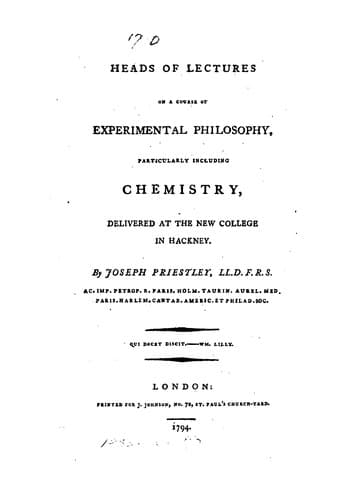
Heads of Lectures on a Course of Experimental Philosophy: Particularly Including ChemistryPriestley, Joseph
Philosophy
Heads of Lectures on a Course of Experimental Philosophy: Particularly Including Chemistry
Priestley, Joseph
Chemistry -- Early works to 1800
The semi-metals are _bismuth_, _zinc_, _nickel_, regulus of _arsenic_,
of _cobalt_, of _antimony_, of _manganese_, of _wolfram_, and of
_molybdena_.
All metallic substances are crystallizable, and each in a peculiar form,
which is discovered by leaving a hole in the bottom of the crucible in
which they are melted, and drawing out the stopper, when the mass is
beginning to lose its fluidity.
Some of the metals will not unite to others when hot, and others of them
will; and such as will unite with others are called _solders_. Thus tin
is a solder for lead, and brass, gold, or silver, for iron.
Ores are never found in regular strata, like the different kinds of
earth; but in places which have formerly been cavities, running in all
directions, with respect to the regular strata, and commonly called
_veins_.
Many of the ores in their natural state are said to be _mineralized_
with arsenic or sulphur, those substances being intimately united with
the metallic earths.
In order to convert the ores into metals, some of them are first reduced
to powder, to wash out the earthy or saline particles. They are then
kept in a red heat, which the workmen call _roasting_, in order to drive
away the arsenic, or sulphur, which are volatile; and in the last place
they are fused in contact with charcoal, or other substances containing
phlogiston; and to promote the fusion, lime-stone is frequently mixed
with them. When the operation is completed, the unmetallic parts are
converted into glass, or _scoria_, which lies on the surface, whereas
the metal is found at the bottom.
To discover the quantity of metal in a small piece of ore is called
_assaying_.
When metals are fused together, the specific gravity, fusibility, and
other properties are changed, and in such a manner as could not be
discovered from the properties of the constituent parts.
_Of Gold._
Gold is the heaviest of all metallic bodies except platina. It appears
yellow or reddish by reflected light, but green or blue by transmitted
light, when it is reduced to thin plates.
Though gold undergoes no change in a common furnace, or burning lens, it
may, in part, at least, be calcined by the electric shock.
Gold has the greatest _ductility_, and in wires of equal diameters, it
has the greatest _tenacity_, of all the metals. One grain of it may be
made to cover 56 square inches; some gold leaf being less than a
200,000th part of an inch thick; and when it is made to cover a silver
wire, the gold upon it may not be more than one twelfth part of the
thickness of the gold leaf.
This metal is soluble in aqua regia; and being precipitated by a
volatile alkali, makes a powder called _aurum fulminans_, which is one
fourth heavier than the gold, and explodes with great violence in a heat
something greater than that of boiling water.
Public-domain text, read in full here on John Shaqi.
Reviews
Reviews
No reviews yet
Be the first to share your thoughts on this work.
Join the Discussion
Join the discussion
Sign in to leave a comment or review.
Sign InorCreate an account