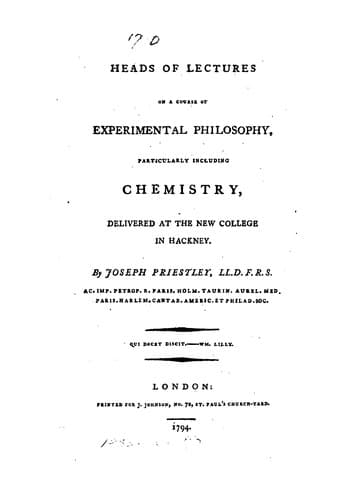
Heads of Lectures on a Course of Experimental Philosophy: Particularly Including Chemistry — John Shaqi
Heads of Lectures on a Course of Experimental Philosophy: Particularly Including ChemistryPriestley, Joseph
Philosophy
Heads of Lectures on a Course of Experimental Philosophy: Particularly Including Chemistry
Priestley, Joseph
Chemistry -- Early works to 1800
A fulminating silver may be made by the following process: the silver
must first be dissolved in pale nitrous acid, then precipitated by
lime-water, dried, and exposed to the air three days. It must then be
washed in caustic volatile alkali, after which the fluid must be
decanted, and the black powder left to dry in the air. The slightest
friction will cause this powder to fulminate. It is said, that even a
drop of water falling upon it will produce this effect; so that it
ought to be made only in very small quantities, and managed with the
greatest caution.
Most of the metals precipitate silver. That by mercury may be made to
assume the form of a tree, called _arbor Dianae_.
Silver is found native in Peru; and the ores frequently contain sulphur,
or arsenic, or both.
_Of Platina._
Platina is a metal lately discovered in the gold mines of Mexico, where
it is found in small particles, never exceeding the size of a pea, mixed
with ferruginous sand and quartz.
The strongest fire will not melt these grains, though it will make them
cohere; but they may be melted by a burning lens, or a blow-pipe
supplied with dephlogisticated air.
Pure platina is the heaviest body in nature, its specific gravity
exceeding twenty-two. It is very malleable, though considerably harder
than gold or silver, and has the property of welding in common with
iron. This metal is not affected by exposure to the air, or by any
simple acid, though concentrated and hot; but it is dissolved by
dephlogisticated marine acid, and by aqua regia, in which a little
nitrous air is procured. The solution is brown, and when diluted yellow.
This liquor is very corrosive, and tinges animal substances of a
blackish brown colour. Platina is precipitated from a solution in aqua
regia by sal-ammoniac, as gold is by martial vitriol. Iron is
precipitated from this solution by the Prussian alkali. Also most of the
metals precipitate platina, but not in its metallic state.
Arsenic facilitates the solution of platina; and by melting it with
equal parts of arsenic and vegetable alkali, and then reducing the mass
to a powder, it may be made to take any form; and a strong heat will
dissipate the arsenic and the alkali, leaving the platina in the shape
required, not fusible by any heat in a common furnace.
Platina does not readily combine with gold or silver, and it resists the
action of mercury as much as iron; but it mixes well with lead, making
it less ductile, and even brittle, according to the proportion of the
platina. With copper it forms a compound which takes a beautiful polish,
not liable to tarnish, and is therefore used with advantage for mirrors
of reflecting telescopes. It unites easily with tin, and also with
bismuth, antimony, and zinc.
LECTURE XXIII.
_Of Mercury._
Public-domain text, read in full here on John Shaqi.
Reviews
Reviews
No reviews yet
Be the first to share your thoughts on this work.
Join the Discussion
Join the discussion
Sign in to leave a comment or review.
Sign InorCreate an account