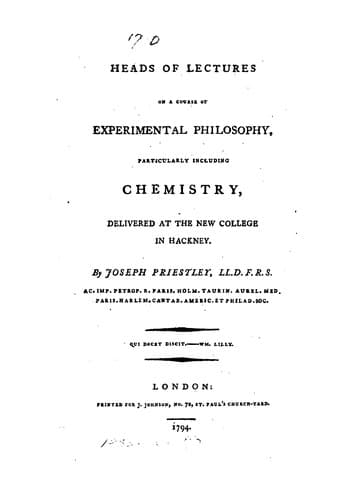
Heads of Lectures on a Course of Experimental Philosophy: Particularly Including Chemistry — John Shaqi
Heads of Lectures on a Course of Experimental Philosophy: Particularly Including ChemistryPriestley, Joseph
Philosophy
Heads of Lectures on a Course of Experimental Philosophy: Particularly Including Chemistry
Priestley, Joseph
Chemistry -- Early works to 1800
Mercury is the most fusible of all the metals, not becoming solid but in
40 deg. below 0 in Fahrenheit's thermometer. It is then malleable. It is
heavier than any other metal except gold or platina. It is volatile in a
temperature much lower than that of boiling water, and in vacuo in the
common temperature of the atmosphere; and at six hundred it boils.
In a degree of heat in which it would rise easily in vapour, mercury
imbibes pure air, and becomes a red calx, called _precipitate per se_.
At a greater degree of heat it parts with that air, and is running
mercury again.
Mercury is not perceptibly altered by exposure to the air.
Mercury is acted upon by the vitriolic acid when hot. In this process
vitriolic acid air is procured, and the mercury is converted into a
white substance, which being dipped in water becomes yellow, called
_turbith mineral_, one third heavier than the mercury from which it was
made. By heat this substance parts with its pure air, and becomes
running mercury; but if the process be made in a clean earthen vessel,
there will remain a portion of _red calx_, which cannot be reduced by
any degree of heat, except in contact with some substance containing
phlogiston. If this be done with a burning lens, in inflammable air,
much of the air will be absorbed.
Mercury is dissolved most readily in the nitrous acid, when the purest
nitrous air is procured; and there remains a substance which is first
yellow, and by continuance red, called _red precipitate_. In a greater
degree of heat the dephlogisticated air will be recovered, and the
mercury be revived; but the substance yields nitrous air after it
becomes solid, and till it changes from yellow to red.
The precipitates of mercury from acids by means of alkalies possess the
property of exploding, when they are exposed to a gradual heat in an
iron spoon, after having been triturated with one sixth of their weight
of the flowers of sulphur. The residuum consists of a violet-coloured
powder, which, by sublimation, is converted into cinnabar.
It seems, therefore, as if the sulphur combined suddenly with the
mercury, and expelled the dephlogisticated air in an elastic state.
The marine acid seizes upon mercury dissolved in nitrous acid, and if
the acid be dephlogisticated, the precipitate is _corrosive sublimate_;
but with common marine acid, it is called _calomel_, or _mercurius
dulcis_. This preparation is generally made in the dry way, by
triturating equal parts of mercury, common salt and vitriol, and
exposing the whole to a moderate heat; when the corrosive sublimate
rises, and adheres to the upper part of the glass vessel in which the
process is made.
Mercury combines readily with sulphur by trituration, and with it forms
a black powder called _Ethiops mineral_. A more intimate combination of
mercury and sulphur is made by means of fire. This is called _cinnabar_,
about one third of which is sulphur. Vermillion is cinnabar reduced to
powder.
Public-domain text, read in full here on John Shaqi.
Reviews
Reviews
No reviews yet
Be the first to share your thoughts on this work.
Join the Discussion
Join the discussion
Sign in to leave a comment or review.
Sign InorCreate an account