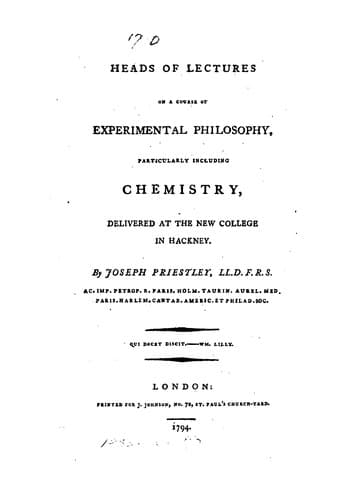
Heads of Lectures on a Course of Experimental Philosophy: Particularly Including ChemistryPriestley, Joseph
Philosophy
Heads of Lectures on a Course of Experimental Philosophy: Particularly Including Chemistry
Priestley, Joseph
Chemistry -- Early works to 1800
Mercury readily unites with oil, and with it forms a deep black or blue
compound, used in medicine.
It readily combines with most of the metals, and when it is used in a
sufficient quantity to make them soft, the mixture is called an
_amalgam_. It combines most readily with gold, silver, lead, tin,
bismuth, and zinc. Looking-glasses are covered on the back with an
amalgam of mercury and tin.
When mercury is united with lead or other metals, it is rendered less
brilliant and less fluid; but agitation in pure air converts the impure
metal into a calx, together with much of the mercury, in the form of a
black powder.
Heat recovers the pure air, and the mercury, leaving the calx of the
impure metal.
Much mercury is found native in a slaty kind of earth, or in masses of
clay or stone; but the greatest quantity is found combined with sulphur
in _native cinnabar_.
LECTURE XXIV.
_Of Lead._
Lead is a metal of a bluish tinge, of no great tenacity, but very
considerable specific gravity, being heavier than silver. It melts long
before it is red hot, and is then calcined, if it be in contact with
respirable air. When boiling it emits fumes, and calcines very rapidly.
It may be granulated by being poured into a wooden box, and agitated.
During congelation it is brittle, so that the parts will separate by the
stroke of a hammer; and by this means the form of its crystals may be
discovered.
In the progress of calcination it first becomes a dusky grey powder,
then yellow, when it is called _massicot_; then, by imbibing pure air,
it becomes red, and is called _minium_, or _red lead_. In a greater
degree of heat it becomes massicot again, having parted with its pure
air. If the heat be too great, and applied rapidly, it becomes a flaky
substance, called _litharge_; and with more heat it becomes a _glass_,
which readily unites with metallic calces and earths, and is a principal
ingredient in the manufacture of _flint glass_, giving it its peculiar
density and refractive power.
Though lead soon tarnishes, the imperfect calx thus made does not
separate from the rest of the metal, and therefore protects it from any
farther action of the air, by which means it is very useful for the
covering of houses, and other similar purposes. All acids act upon lead,
and form with it different saline substances. _White-lead_ consists of
its union with vinegar and pure air. Also dissolved in vinegar, and
crystallized, it becomes _sugar of lead_, which, like all the other
preparations of this metal, is a deadly poison.
Oils dissolve the calces of lead, which, by this means, is the basis of
paints, plaisters, &c.
By means of heat litharge decomposes common salt, the lead uniting with
the marine acid, and forming a yellow substance, used in painting, and
by this means the fossil alkali is separated.
Public-domain text, read in full here on John Shaqi.
Reviews
Reviews
No reviews yet
Be the first to share your thoughts on this work.
Join the Discussion
Join the discussion
Sign in to leave a comment or review.
Sign InorCreate an account