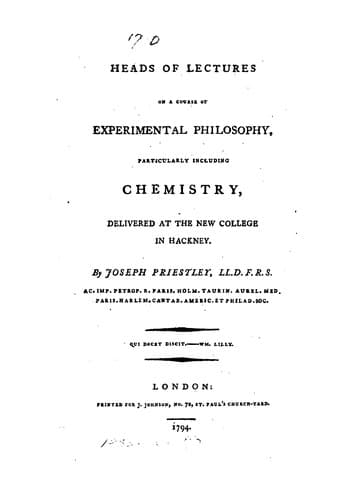
Heads of Lectures on a Course of Experimental Philosophy: Particularly Including ChemistryPriestley, Joseph
Philosophy
Heads of Lectures on a Course of Experimental Philosophy: Particularly Including Chemistry
Priestley, Joseph
Chemistry -- Early works to 1800
Lead unites with most metals, though not with iron. Two parts of lead
and one of tin make a _solder_, which melts with less heat than either
of the metals separately; but a composition of eight parts of bismuth,
five of lead, and three of tin, makes a metal which melts in boiling
water.
This metal will be dissolved by water if it contain any saline matter,
and the drinking of it occasions a peculiar kind of cholic.
Lead is sometimes found native, but generally minerally mineralized with
sulphur or arsenic, and often mixed with a small quantity of silver.
_Of Copper._
Copper is a metal of a reddish or brownish colour, considerably
sonorous, and very malleable.
At a heat far below ignition, the surface, of copper becomes covered
with a range of prismatic colours, the commencement of its calcination;
and with more heat a black scale is formed, which easily separates from
the metal, and in a strong heat it melts, and burns with a bluish green
flame.
Copper rusts by exposure to the air; but the partially-calcined surface
adheres to the metal, as in the case of lead, and thus preserves it from
farther corrosion.
Copper dissolved in the vitriolic acid forms crystals of a blot colour,
called _blue copperas_. From this solution it is precipitated by iron,
which by this means becomes coated with copper. The nitrous acid
dissolves copper with most rapidity, producing nitrous air. If the
solution be distilled, almost all the acid will be retained in the
residuum, which is white; but more heat will expel the acid, chiefly in
the form of dephlogisticated air, and the remainder will be a black
substance, consisting of the pure calx of copper. The vegetable acids
dissolve copper as well as the mineral ones, which makes the use of this
metal for culinary purposes in some cases dangerous. To prevent this
they give it a coat of tin. The solution of copper in the vegetable acid
is called _verdigris_.
Alkalies dissolve copper as well as acids. With the volatile alkali a
blue liquor is formed, but in some cases it becomes colourless. All the
circumstances of this change of colour have not yet been examined. Both
oil and sulphur will dissolve copper, and with the latter it forms a
blackish grey compound, used by dyers.
Copper readily unites with melted tin, at a temperature much lower than
that which is necessary to melt the copper; by which means copper
vessels are easily covered with a coating of tin. A mixture of copper
and tin, called _bronze_, the specific gravity of which is greater than
that of the medium of the two metals, is used in casting statues,
cannon, and bells; and in a certain proportion this mixture is excellent
for the purpose of mirrors of reflecting telescopes, receiving a fine
polish, and not being apt to tarnish. Copper and arsenic make a brittle
compound called _tombach_; and with zinc it makes the useful compound
commonly called _brass_, in which zinc is about one third of its weight.
Public-domain text, read in full here on John Shaqi.
Reviews
Reviews
No reviews yet
Be the first to share your thoughts on this work.
Join the Discussion
Join the discussion
Sign in to leave a comment or review.
Sign InorCreate an account