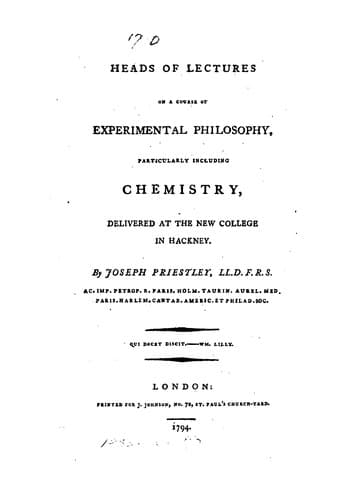
Heads of Lectures on a Course of Experimental Philosophy: Particularly Including ChemistryPriestley, Joseph
Philosophy
Heads of Lectures on a Course of Experimental Philosophy: Particularly Including Chemistry
Priestley, Joseph
Chemistry -- Early works to 1800
If the conducting plate of the electrophorus be applied to a piece of
dry wood, marble, or any other substance through which electricity can
pass but very slowly, or if the insulated conducting plate be covered
with a piece of thin silk, which will make some resistance to the
passage of electricity, and it be then applied to another plate
communicating with the earth; and if, in either of these cases, a body
with a large surface possessed of a weak electricity be applied to the
conducting plate, the weak electricity not being able to overcome the
obstruction presented to it, so as to be communicated to the other
plate, will affect it with the contrary electricity, and this reacting
on the first plate, will condense its electricity on that part of the
plate to which it is contiguous; in consequence of which its capacity of
receiving electricity will be increased; so that on the separation of
the two plates, that electricity which was before condensed, being
equally diffused through the whole plate, will have a greater intensity
than it had before, attracting light bodies, or even giving a spark,
when the body from which it received its electricity was incapable of
it. For though it contained a great quantity of electricity, it was
diffused through so large a space that its intensity was very small.
This instrument is therefore called a _condenser of electricity_.
If an insulated plate of metal possessing the smallest degree of
electricity be presented very near to another plate communicating with
the earth, it will affect this plate with the opposite electricity; and
this being, in the same manner, applied to a third plate, will put it
into the same state with the first. If then these two plates be joined,
and the first plate be presented to either of them, its own electricity
being attracted by that of the plate presented, that of the other will
be drawn into it, so that its quantity will be doubled. The same process
being repeated, will again double the electricity of this plate, till,
from being quite insensible to the most exquisite electrometer, it will
become very conspicuous, or even give sparks. This instrument is
therefore called a _doubler of electricity_, of excellent use in
ascertaining the quality of atmospherical electricity when ever so
small. If this instrument be so constructed that these three plates can
be successively presented to one another by the revolution of one of
them on an axis, it is called the _revolving doubler_; and in this form
it is most convenient for use.
THE END.
Transcriber's Note: Details of corrections
Public-domain text, read in full here on John Shaqi.
Reviews
Reviews
No reviews yet
Be the first to share your thoughts on this work.
Elsewhere in the archive
Join the Discussion
Join the discussion
Sign in to leave a comment or review.
Sign InorCreate an account