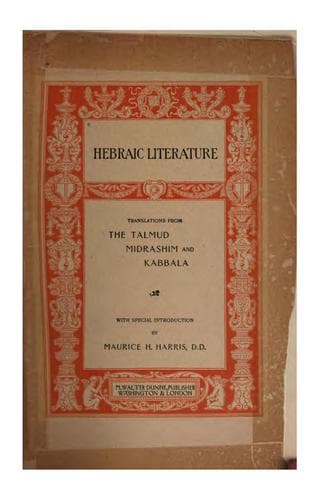
Hebraic Literature; Translations from the Talmud, Midrashim and Kabbala
Religion
Hebraic Literature; Translations from the Talmud, Midrashim and Kabbala
Hebrew literature -- Translations into English
Ten things are said about Jerusalem:--(1.) No mortgaged house was
eventually alienated from its original owner (which was the case
elsewhere in Jewry). (2.) Jerusalem never had occasion to behead a
heifer by way of expiation for an unproved murder (see Deut. xxi. 1-9).
(3.) She never could be regarded as a repudiated city (Deut. xiii. 12,
etc.). (4.) No appearance of plagues in any house at Jerusalem rendered
the house unclean, because the words of Lev. xiv. 34, are "your
possession," an expression which could not apply to Jerusalem, as it had
never been portioned among the ten tribes. (5.) Projecting cornices and
balconies were not to be built in the city. (6.) Limekilns were not to
be erected there. (7.) No refuse heaps were allowed in any quarter. (8.)
No orchards or gardens were permitted, excepting certain flower-gardens,
which had been there from the times of the earlier prophets. (9.) No
cocks were reared in Jerusalem. (10.) No corpse ever remained over night
within its walls; the funeral had to take place on the day of the
decease.
Ibid., fol. 82, col. 2.
In the Book of Psalms David included those which were composed by ten
elders:--Adam (Ps. cxxxix.); Melchizedek (Ps. cx.); Abraham (Ps.
lxxxix.); Moses (Ps. xc.); the others alluded to were by Heman,
Jeduthun, Asaph, and the three sons of Korah.
_Bava Bathra_, fol. 14, col. 2.
A man once overheard his wife telling her daughter that, though she had
ten sons, only one of them could fairly claim her husband as his father.
After the father's death it was found that he had bequeathed all his
property to one son, but that the testament did not mention his name.
The question therefore, arose, which of the ten was intended? So they
came one and all to Rabbi Benaah and asked him to arbitrate between
them. "Go," said he to them, "and beat at your father's grave, until he
rises to tell you to which of you it was that he left the property." All
except one did so; and he, because by so doing he showed most respect
for his father's memory, was presumed to be the one on whom the father
had fixed his affections; he accordingly was supposed to be the one
intended, and the others were therefore excluded from the patrimony. The
disappointed ones went straight to the government and denounced the
Rabbi. "Here is a man," said they, "who arbitrarily deprives people of
their rights, without proof or witnesses." The consequence was that the
Rabbi was sent to prison, but he gave the authorities such evidence of
his shrewdness and sense of justice, that he was soon restored to
freedom.
_Bava Bathra_, fol. 58, col. 1.
Till ten generations have passed speak thou not contemptuously of the
Gentiles in the hearing of a proselyte.
_Sanhedrin_, fol. 94, col. 1.
Public-domain text, read in full here on John Shaqi.
Reviews
Reviews
No reviews yet
Be the first to share your thoughts on this work.
Elsewhere in the archive
Join the Discussion
Join the discussion
Sign in to leave a comment or review.
Sign InorCreate an account