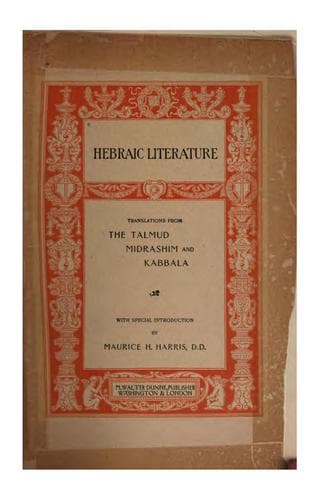
Hebraic Literature; Translations from the Talmud, Midrashim and Kabbala
Religion
Hebraic Literature; Translations from the Talmud, Midrashim and Kabbala
Hebrew literature -- Translations into English
See Bereshith Rabba, fol. 4, with reference to what is here said
about Turnus Rufus and his father's grave. The proof from the
necromancer lies in the allegation that his art was unsuccessful
if practiced on the Sabbath-day. The Sambatyon, Rashi says, is a
pebbly river which rushes along all the days of the week except
the Sabbath, on which it is perfectly still and quiet. In the
Machsor for Pentecost (D. Levi's ed. p. 81), it is styled "the
incomprehensible river," and a footnote thereto informs us that
"This refers to the river said to rest on the Sabbath from
throwing up stones, etc., which it does not cease to do all the
rest of the week." (See Sanhedrin, fol. 65, col. 2; Yalkut on
Isaiah, fol. 3, 1; Pesikta Tanchuma. See also Shalsheleth
Hakabbala and Yuchsin.)
Those Israelites and Gentiles who have transgressed with their bodies
(the former by neglecting to wear phylacteries, and the latter by
indulging in sensuous pleasures), shall go down into Gehenna, and there
be punished for twelve months, after which period their bodies will be
destroyed and their soul consumed, and a wind shall scatter their ashes
under the soles of the feet of the righteous; as it is said (Mal. iv.
3), "And ye shall tread down the wicked; for they shall be as ashes
under the soles of your feet." But the Minim, the informers, and the
Epicureans, they who deny the law and the resurrection of the dead, they
who separate themselves from the manners of the congregation, they who
have been a terror in the land of the living, and they who have sinned
and have led the multitude astray, as did Jeroboam the son of Nebat and
his companions,--these shall go down into Gehenna, and there be judged
for generations upon generations, as it is said (Isa. lxvi, 24), "And
they shall go forth and look upon the carcasses of the men that have
transgressed against me," etc. Gehenna itself shall be consumed but they
shall not be burned up in the destruction; as it is said (Ps. xlix, 14;
Heb. xv.), "And their figures shall consume hell from being a dwelling."
_Rosh Hashanah_, fol. 17, col. 1.
Public-domain text, read in full here on John Shaqi.
Reviews
Reviews
No reviews yet
Be the first to share your thoughts on this work.
Elsewhere in the archive
Join the Discussion
Join the discussion
Sign in to leave a comment or review.
Sign InorCreate an account