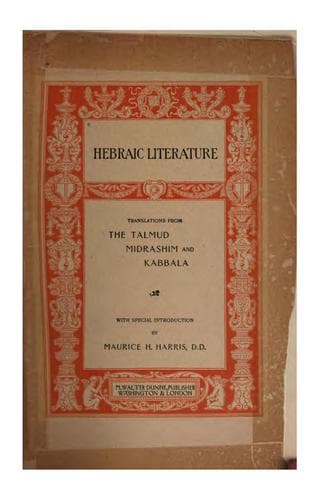
Hebraic Literature; Translations from the Talmud, Midrashim and Kabbala
Religion
Hebraic Literature; Translations from the Talmud, Midrashim and Kabbala
Hebrew literature -- Translations into English
By forty-eight things the law is acquired. These are study, attention,
careful conversation, mental discernment, solicitude, reverential fear,
meekness, geniality of soul, purity, attention to the wise, mutual
discussion, debating, sedateness, learning in the Scripture and the
Mishna, not dabbling in commerce, self-denial, moderation in sleep,
aversion to gossip, etc., etc.
_Avoth_, chap. 6.
When God gave the law to Moses, He assigned forty-nine reasons in every
case for pronouncing one thing unclean and as many for pronouncing other
things clean.
_Sophrim_, chap. 16, mish. 6.
He that has fifty zouzim, and trades therewith, may not glean what is
left in the corner of the field (Lev. xix. 9). He that takes it, and has
no right to it, will come to want before the day of his departure. And
if one who is entitled to it leaves it to others more needy, before he
dies he will not only be able to support himself, but be a stay to
others.
_Peah_, chap. 8, mish. 9.
Fifty measures of understanding were created in the world, and all
except one were given to Moses; as it is said (Ps. viii. 5), "Thou hast
made him a little lower than the angels."
_Rosh Hashanah_, fol. 21, col, 2.
Poverty in a house is harder to bear than fifty plagues.
_Bava Bathra_, fol 116, col. 1.
The above saying is based on Job xix. 21, compared with Exod.
viii. 19.
For fifty-two years no man traveled through the land of Judea.
_Yoma_. fol. 54, col. 1.
Black cummin is one of the sixty deadly drugs.
_Berachoth_, fol. 40, col. 1.
Ulla and Rav Chasda were once traveling together, when they came up to
the gate of the house of Rav Chena bar Chenelai. At sight of it Rav
Chasda stooped and sighed. "Why sighest thou?" asked Ulla, "seeing, as
Rav says, sighing breaks the body in halves; for it is said (Ezek. xxi.
6), 'sigh, therefore, O son of man, with the breaking of thy loins;' and
Rabbi Yochanan says a sigh breaks up the whole constitution; for it is
said (Ezek. xxi. 7), 'And it shall be when they say unto thee, Wherefore
sighest thou? that thou shalt answer, For the tidings because it cometh,
and the whole heart shall melt,'" etc. To this Rav Chasda replied, "How
can I help sighing over this house, where sixty bakers used to be
employed during the day, and sixty during the night, to make bread for
the poor and needy; and Rav Chena had his hand always at his purse, for
he thought the slightest hesitation might cause a poor but respectable
man to blush; and besides he kept four doors open, one to each quarter
of the heavens, so that all might enter and be satisfied? Over and above
this, in time of famine he scattered wheat and barley abroad, so that
they who were ashamed to gather by day might do so by night; but now
this house has fallen into ruin, and ought I not to sigh?"
Ibid., fol. 58, col. 2.
Public-domain text, read in full here on John Shaqi.
Reviews
Reviews
No reviews yet
Be the first to share your thoughts on this work.
Elsewhere in the archive
Join the Discussion
Join the discussion
Sign in to leave a comment or review.
Sign InorCreate an account