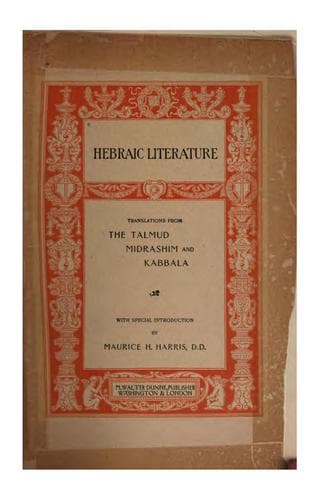
Hebraic Literature; Translations from the Talmud, Midrashim and Kabbala
Religion
Hebraic Literature; Translations from the Talmud, Midrashim and Kabbala
Hebrew literature -- Translations into English
Abaii says, "When I left Rabbah, I was not at all hungry; but when I
arrived at Meree, they served up before me sixty dishes, with as many
sorts of viands, and I ate half of each, but as for hotch-potch, which
the last dish contained, I ate up all of it, and would fain have eaten
up the dish too." Abaii said, "This illustrates the proverb, current
among the people, 'The poor man is hungry, and does not know when he has
eaten enough; or, there is always room for a tit-bit.'"
_Meggillah_, fol. 7, col. 2.
There are sixty kinds of wine; the best of all is the red aromatic wine,
and bad white wine is the worst.
_Gittin_, fol. 70, col. 1.
Samson's shoulders were sixty ells broad.
_Soteh_, fol. 10, col. 1.
Ebal and Gerizim were sixty miles from Jordan.
Ibid., fol. 36, col. 1.
One who makes a good breakfast can outstrip sixty runners in a race (who
have not).
_Bava Kama_, fol. 92, col. 2.
A (hungry) person who looks on while another eats, experiences sixty
unpleasant sensations in his teeth.
Ibid.
His wife made him daily sixty sorts of dainties, and these restored him
again.
_Bava Metzia_, fol. 84, col. 2.
Rabbi Blazar, the son of Rabbi Shimon, once vindictively caused
a man to be put to death, merely because he had spoken of him as
Vinegar the son of Wine, a round-about way of reproaching him
that he was the bad son of a good father, though it turned out
afterward that the condemned man deserved death for a crime that
he was not known to be guilty of at the time of his execution;
yet the mind of the Rabbi was ill at ease, and he voluntarily
did penance by subjecting himself in a peculiar fashion to great
bodily suffering. Sixty woolen cloths were regularly spread
under him every night, and these were found soaked in the
morning with his profuse perspiration. The result of this was
greater and greater bodily prostration, which his wife strove,
as related above, day after day to repair, detaining him from
college, lest the debates there should prove too much for his
weakened frame. When his wife found that he persisted in
courting these sufferings, and that her tender care, as well as
her own patrimony, were being lavished on him in vain, she tired
of her assiduity, and left him to his fate. And now, waited on
by some sailors, who believed they owed to him deliverance from
a watery grave, he was free to do as he liked. One day, being
ministered to by them after a night's perspiration of the kind
referred to, he went straight to college, and there decided
sixty doubtful cases against the unanimous dissent of the
assembly. Providential circumstances, which happened afterward,
both proved that he was right in his judgment and that his wife
was wrong in suffering her fondness for him to stand in the way
of the performance of his public duties.
Public-domain text, read in full here on John Shaqi.
Reviews
Reviews
No reviews yet
Be the first to share your thoughts on this work.
Elsewhere in the archive
Join the Discussion
Join the discussion
Sign in to leave a comment or review.
Sign InorCreate an account