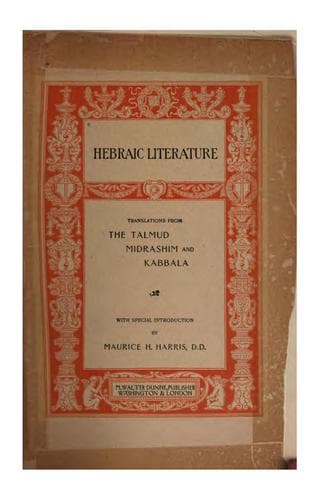
Hebraic Literature; Translations from the Talmud, Midrashim and Kabbala
Religion
Hebraic Literature; Translations from the Talmud, Midrashim and Kabbala
Hebrew literature -- Translations into English
Let judges know with whom and before whom they judge, and who it is that
will one day exact account of their judgments; for it is said (Ps.
lxxxii. 1), "God standeth in the assembly of God, and judgeth with the
judges."
_Sanhedrin_, fol. 6, col. 2.
A judge who does not judge justly causeth the Shechinah to depart from
Israel; for it is said (Ps. xii. 5), "For the oppression of the poor,
the sighing of the needy, now will I depart, saith the Lord."
_Sanhedrin_, fol. 7, col. 1.
The judge should ever regard himself as if he had a sword laid upon his
thigh, and Gehenna were yawning near him; as it is said (Solomon's Song,
iii. 7, 8), "Behold the bed of Solomon (the judgment-seat of God),
threescore valiant men are about it, of the valiant of Israel. They all
hold swords, being expert in war (with injustice). Every one has his
sword upon his thigh, for fear of the night" (the confusion that would
follow).
_Yevamoth_, fol. 109, col. 2; _Sanhedrin_, fol. 7, col. 1.
Seven have, in the popular regard, no portion in the world to come: a
notary, a schoolmaster, the best of doctors, a judge in his native
place, a conjuror, a congregational reader, and a butcher.
_Avoth d' Rabbi Nathan_, chap. 36.
WITNESSES.
An ignoramus is ineligible for a witness.
The following are ineligible as witnesses of the appearance of the new
moon:--Dice-players, usurers, pigeon-fliers, sellers of the produce of
the year of release, and slaves. This is the general rule; in any case
in which women are inadmissible as witnesses, they also are inadmissible
here.
_Rosh Hashanah_, fol. 22, col. 1.
Two disciples of the wise happened to be shipwrecked with Rabbi Yossi
ben Simaii, and the Rabbi allowed their widows to re-marry on the
testimony of women. Even the testimony of a hundred women is only equal
to the evidence of one man (and that only in a case like the foregoing;
it is inadmissible in any other matter).
_Yevamoth_, fol. 115, col. 1.
"Whosoever is not instructed in Scripture, in the Mishna, and in good
manners," says Rabbi Yochanan, "is not qualified to act as a witness."
"He who eats in the street," say the Rabbis, "is like a dog;" and some
add that such a one is ineligible as a witness, and Rav Iddi bar Avin
says the Halachah is as "some say."
_Kiddushin_, fol. 40, col. 2.
Even when a witness is paid, his testimony is not thereby invalidated.
_Kiddushin_, fol. 58, col. 2.
Testimony that is invalidated in part is invalidated entirely.
_Bava Kama_, fol, 73, col. 1.
Let witnesses know with whom and before whom they bear testimony, and
who will one day call them to account; for it is said (Deut. xix. 17),
"Both the men between whom the controversy is shall stand before the
Lord."
_Sanhedrin_, fol. 6, col. 2.
Those that eat another thing (i.e., not pork, but those who receive
charity from a Gentile.--Rashi and Tosefoth) are disqualified from being
witnesses. When is this the case? When done publicly; but if in secret,
not so.
Ibid., fol. 26, col. 2.
Public-domain text, read in full here on John Shaqi.
Reviews
Reviews
No reviews yet
Be the first to share your thoughts on this work.
Elsewhere in the archive
Join the Discussion
Join the discussion
Sign in to leave a comment or review.
Sign InorCreate an account