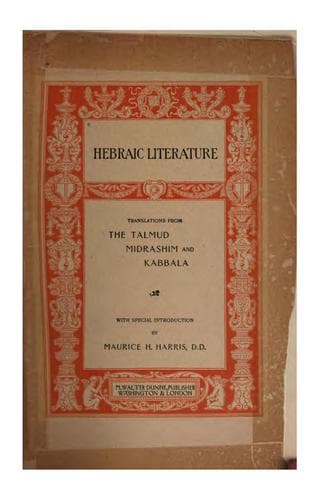
Hebraic Literature; Translations from the Talmud, Midrashim and Kabbala
Religion
Hebraic Literature; Translations from the Talmud, Midrashim and Kabbala
Hebrew literature -- Translations into English
When one is ordered to construct a booth, or to prepare a palm-branch
for the Feast of Tabernacles, or to make fringes, and does not do so, he
is to be flogged till his soul comes out of him.
_Chullin_, fol. 132, col. 2.
Once on a time, as the Rabbis relate, the wicked Government sent two
officers to the wise men of Israel, saying, "Teach us your law." This
being put into their hands, three times over they perused it; and when
about to leave they returned it, remarking, "We have carefully studied
your law, and find it equitable save in one particular. You say: When
the ox of an Israelite gores to death the ox of an alien, its owner is
not liable to make compensation; but if the ox of an alien gore to death
the ox of an Israelite, its owner must make full amends for the loss of
the animal; whether it be the first or second time that the ox has so
killed another (in which case an Israelite would have to pay to another
Israelite only half the value of the loss), or the third time (when he
would be fined to the full extent of his neighbor's loss). Either
'neighbor' (in Exod. xxi. 35, for such the word signifies in the
original Hebrew, though the Authorized Version has another) is taken
strictly as referring to an Israelite only, and then an alien should be
exempted as well; or if the word 'neighbor' is to be taken in its widest
sense, why should not an Israelite be bound to pay when his ox gores to
death the ox of an alien?" "This legal point," was the answer, "we do
not tell the Government." As Rashi says in reference to the preceding
Halacha, "an alien forfeits the right to his own property in favor of
the Jews."
_Bava Kama_, fol. 38, col. 1.
Ptolemy, the king (of Egypt), assembled seventy-two elders of Israel and
lodged them in seventy-two separate chambers, but did not tell them why
he did so. Then he visited each one in turn and said, "Write out for me
the law of Moses your Rabbi." The Holy One--blessed be He!--went and
counseled the minds of every one of them, so that they all agreed, and
wrote, "God created in the beginning," etc.
_Megillah_, fol. 9, col. 1.
The Talmudic story of the origin of the Septuagint agrees in the
main with the account of Aristeas and Josephus, but Philo gives
the different version. Many of the Christian fathers believed it
to be the work of inspiration.
Abraham was as tall as seventy-four people; what he ate and drank was
enough to satisfy seventy-four ordinary men, and his strength was
proportionate.
_Sophrim_, chap. 21, 9.
Public-domain text, read in full here on John Shaqi.
Reviews
Reviews
No reviews yet
Be the first to share your thoughts on this work.
Elsewhere in the archive
Join the Discussion
Join the discussion
Sign in to leave a comment or review.
Sign InorCreate an account