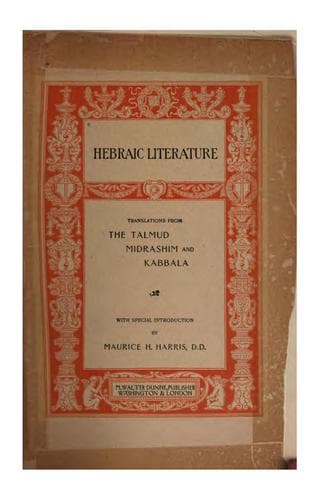
Hebraic Literature; Translations from the Talmud, Midrashim and Kabbala
Religion
Hebraic Literature; Translations from the Talmud, Midrashim and Kabbala
Hebrew literature -- Translations into English
It is related of Johanan, the son of Narbai, that he used to eat three
hundred calves, and to drink three hundred bottles of wine, and to
consume forty measures of young pigeons by way of dessert. (Rashi says
this was because he had to train many priests in his house.)
_P'sachim_, fol. 57, col. 1.
The keys of the treasury of Korah were so many that it required three
hundred white mules to carry them. These, with the locks, were said to
be made of white leather.
Ibid., fol. 119, col. 1.
The Midrash repeats the same story, and adds, "His wealth was
his ruin." "He is as rich as Korah" is now a Jewish proverb.
Rav Chiya, the son of Adda, was tutor to the children of Resh Lakish,
and once absented himself from his duties for three days. On his return
he was questioned as to the reason of his conduct, and he gave the
following reply: "My father bequeathed to me a vine, trained on high
trellis-work as a bower, from which I gathered the first day three
hundred bunches, each of which yielded a gerav of wine (a gerav is a
measure containing as much as 288 egg-shells would contain). On the
second day I again gathered three hundred bunches of smaller size, two
only producing one gerav (one bunch yielding the quantity of wine 144
egg-shells would contain). The third day I also gathered three hundred
bunches, but only three bunches to the gerav, and have yet left more
than half of the grapes free for any one to gather them." Thereupon Resh
Lakish observed to him, "If thou hadst not been so negligent (losing
time in the instruction of my children), it would have yielded still
more."
_Kethuboth_, fol. 111, col. 2.
There were three hundred species of male demons in Sichin, but what the
female demon herself was like is known to no one.
_Gittin_, fol. 68, col. 1.
"Now, when Job's three friends heard of all this evil that was come upon
him, they came each from his own place; Eliphaz the Temanite, Bildah the
Shuhite, and Zophar the Naamathite: for they had made an appointment
together to come and mourn with him, and to comfort him" (Job ii. 11).
What is meant when it is said, "They had made an appointment together"?
Rab. Yehudah says in the name of Rav, "This is to teach that they all
came in by one gate." But there is a tradition that each lived three
hundred miles away from the other. How then came they to know of Job's
sad condition? Some say they had wreaths, others say trees (each
representing an absent friend), and when any friend was in distress the
one representing him straightway began to wither. Rava said, "Hence the
proverb, 'Either a friend as the friends of Job, or death.'"
_Bava Bathra_, fol. 16, col. 2.
Rashi tenders this explanation, that Job and his friends had
each wreaths with their names engraved on them, and if
affliction befell any one his name upon the wreath would change
color.
Public-domain text, read in full here on John Shaqi.
Reviews
Reviews
No reviews yet
Be the first to share your thoughts on this work.
Elsewhere in the archive
Join the Discussion
Join the discussion
Sign in to leave a comment or review.
Sign InorCreate an account