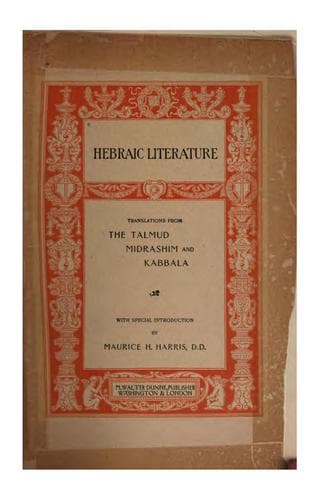
Hebraic Literature; Translations from the Talmud, Midrashim and Kabbala
Religion
Hebraic Literature; Translations from the Talmud, Midrashim and Kabbala
Hebrew literature -- Translations into English
All the prophets were rich men. This we infer from the account of Moses,
Samuel, Amos, and Jonah. Of Moses, as it is written (Num. xvi. 15), "I
have not taken one ass from them." Of Samuel, as it is written (1 Sam.
xii. 3), "Behold, here I am; witness against me before the Lord, and
before His anointed, whose ox have I taken? or whose ass have I taken?"
Of Amos, as it is written (Amos vii. 14), "I was an herdsman and a
gatherer of sycamore fruit," i.e., I am proprietor of my herds and own
sycamores in the valley. Of Jonah, as it is written (Jonah i. 3), "So he
paid the fare thereof and went down into it." Rabbi Yochanan says he
hired the whole ship. Rabbi Rumanus says the hire of the ship amounted
to four thousand golden denarii.
_Nedarim_, fol. 38, col. 1.
Four thousand two hundred and thirty-one years after the creation of the
world, if any one offers thee for one single denarius a field worth a
thousand denarii, do not buy it.
_Avodah Zarah_, fol. 9, col. 2.
Rashi gives this as the reason of the prohibition: For then the
restoration of the Jews to their own land will take place, so
that the denarius paid for a field in a foreign land would be
money thrown away.
Four thousand two hundred and ninety-one years after the creation of the
world the wars of the dragons and the wars of Gog and Magog will cease,
and the rest of the time will be the days of the Messiah; and the Holy
One--blessed be He!--will not renew His world till after seven thousand
years.... Rabbi Jonathan said, "May the bones of those who compute the
latter days (when the Messiah shall appear) be blown; for some say,
'Because the time (of Messiah) has come and Himself has not, therefore
He will never come!' But wait thou for Him, as it is said (Hab. ii. 3),
'Though He tarry, wait for Him.' Perhaps you will say, 'We wait, but He
does not wait;' learn rather to say (Isa. xxx. 18), 'And therefore will
the Lord wait, that He may be gracious unto you; and therefore will He
be exalted, that He may have mercy upon you.'"
_Sanhedrin_, fol. 97, col. 2.
It is related of Rabbi Tarphon (probably the Tryphon of polemic fame)
that he was very rich, but gave nothing to the poor. Once Rabbi Akiva
met him and said, "Rabbi, dost thou wish me to purchase for thee a town
or two?" "I do," said he, and at once gave him four thousand gold
denarii. Rabbi Akiva took this sum and distributed it among the poor.
Some time after Rabbi Tarphon met Rabbi Akiva and said, "Where are the
towns thou purchasedst for me?" The latter seized hold of him by the arm
and led him to the Beth Hamedrash, where, taking-up a psalter, they read
together till they came to this verse, "He hath dispersed, he hath given
to the poor, his righteousness endureth forever" (Ps. cxii. 9). Here
Rabbi Akiva paused and said, "This is the place I purchased for thee,"
and Rabbi Tarphon saluted him with a kiss.
_Tract. Callah._
Public-domain text, read in full here on John Shaqi.
Reviews
Reviews
No reviews yet
Be the first to share your thoughts on this work.
Elsewhere in the archive
Join the Discussion
Join the discussion
Sign in to leave a comment or review.
Sign InorCreate an account