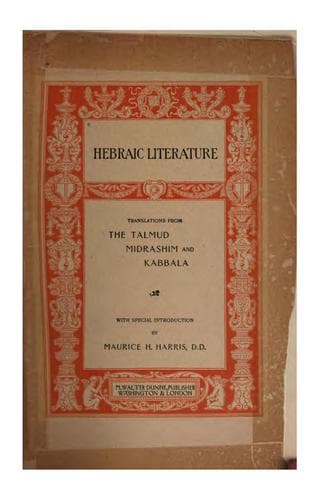
Hebraic Literature; Translations from the Talmud, Midrashim and Kabbala
Religion
Hebraic Literature; Translations from the Talmud, Midrashim and Kabbala
Hebrew literature -- Translations into English
from his lips his soul departed from his body, and a voice was heard
from heaven proclaiming, "Blessed art thou, Ravah bar Nachmaini, for thy
body is clean. 'Clean' was the word on thy lips when thy spirit
departed." Then a scroll fell down from heaven into Pumbeditha
announcing that Ravah bar Nachmaini was admitted into the academy of
heaven. Apprised of this, Abaii, in company with many other Rabbis, went
in search of the body to inter it, but not knowing the spot where he
lay, they went to Agma, where they noticed a great number of birds
hovering in the air, and concluded that the shadow of their wings
shielded the body of the departed. There, accordingly, they found and
buried him; and after mourning three days and three nights over his
grave, they arose to depart, when another scroll descended threatening
them with excommunication if they did so. They therefore continued
mourning for seven days and seven nights, when, at the end of these, a
third scroll descended and bade them go home in peace. On the day of the
death of this Rabbi there arose, it is said, such a mighty tempest in
the air that an Arab merchant and the camel on which he was riding were
blown bodily over from one side of the river Pappa to the other. "What
meaneth such a storm as this?" cried the merchant, as he lay on the
ground. A voice from heaven answered, "Ravah bar Nachmaini is dead."
Then he prayed and fled, "Lord of the universe, the whole world is
Thine, and Ravah bar Nachmaini is Thine! Thou art Ravah's and Ravah is
Thine; but wherefore wilt Thou destroy the world?" On this the storm
immediately abated, and there was a perfect calm.
_Bava Metzia_, fol. 86, col. 1.
The above seems to be a Rabbinical satire on the Talmud itself
although the orthodox Jews believe that every word in it is
historically true. Well, perhaps it is so; and we outsiders are
ignorant, and without the means of judging.
Now we know what God does during the day, but how does He occupy Himself
in the night-time? We may say He does the same as at day-time; or that
during the night He rides on a swift cherub over eighteen thousand
worlds; as it is said (Ps. lxviii. 17), "The chariots of God are twenty
thousand," less two thousand Shinan; read not Shinan but She-einan,
i.e., two thousand less than twenty thousand, therefore eighteen
thousand.
_Avodah Zarah_, fol. 3. col. 2.
Prince Contrukos asked Rabbon Yochanan ben Zacchai how, when the
detailed enumeration of the Levites amounted to twenty-two thousand
three hundred (the Gershonites, 7500; the Kohathites, 8600; the
Merarites, 6200, making in all 22,300), the sum total given is only
twenty-two thousand, omitting the three hundred. "Was Moses, your
Rabbi," he asked, "a cheat or a bad calculator?" He answered, "They were
first-borns, and therefore could not be substitutes for the first-born
of Israel."
_Bechoroth_, fol. 5, col. 1.
Public-domain text, read in full here on John Shaqi.
Reviews
Reviews
No reviews yet
Be the first to share your thoughts on this work.
Elsewhere in the archive
Join the Discussion
Join the discussion
Sign in to leave a comment or review.
Sign InorCreate an account