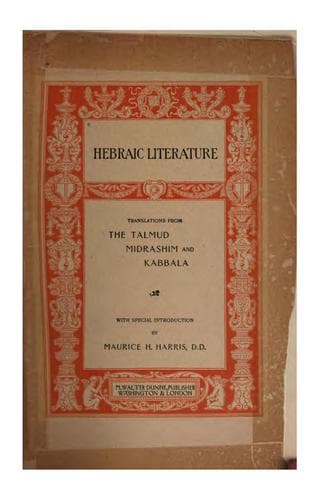
Hebraic Literature; Translations from the Talmud, Midrashim and Kabbala
Religion
Hebraic Literature; Translations from the Talmud, Midrashim and Kabbala
Hebrew literature -- Translations into English
After having prepared himself for immersion, as above described,
he is to turn his face and bow first toward the west and then
toward the east, repeating a certain formula, and then dip
himself under the water. This over, he is to turn again east and
west and repeat a different formula, and while meditating on
certain given letters of certain mystical divine names and other
known words, and their respective numerical values, he is to dip
a second time under the water. Then turning and bowing again
west and east, repeating the while a different formula, he
proceeds to meditate on different letters of the divine names,
and dips for the third and last time. As dipping fourteen times
is the exception and not the rule, no farther directions are
given about the matter, except a few additional formulae and
meditations.
When he comes out of the water he is to step backward in the
same respectful manner as when he leaves the synagogue, and is
to repeat Isa. iv. 3, 4, and Rabbi Akiva's commentary on the
text Ezek. xxxvi. 25.
When he begins dressing he is to repeat Isa. liv. 17, and when
he subsequently washes his face and hands and feet in warm
water, to which is attached a great mystery, he is to say,
"Behold, here I am, washing myself in honor of Sabbath the
queen;" and add also Isa. iv. 4, and also, "I have washed my
feet; how shall I defile them?" (Cant. v. 3.)
Happy is he who is able to provide himself with a complete suit
of apparel down to the girdle, the shoes, and the hat for
wearing on the Sabbath, different from those worn on week-days.
Then he is to repeat the Book of Solomon's Song, and if unable
to repeat the whole, he is, at all events, to repeat these four
verses, the initials of the first word in each of which taken
together form the word Jacob, Cant. i. 2, ii. 10, ii. 8, v. 1.
After this he is to repeat certain portions of the Mishnah, and
something of the Zohar or some other Kabbalistic work.
This over, the devout Israelite goes to the synagogue to meet
his God as the bridegroom, and to receive the Sabbath as the
bride. The service is well worthy of rehearsal, but we must
refer for details to the Liturgy.
The Israelite returns home from the synagogue accompanied by two
angels, one good and the other evil; and according to the
condition of the domestic arrangements when he re-enters, he is
blessed by the good angel or cursed by the evil one.
The Israelite is solemnly warned not to quarrel with his wife on
Sabbath-eve, for the devils are very busy then to stir up more
strife, as is illustrated by the story of Rabbi Meir.
Public-domain text, read in full here on John Shaqi.
Reviews
Reviews
No reviews yet
Be the first to share your thoughts on this work.
Elsewhere in the archive
Join the Discussion
Join the discussion
Sign in to leave a comment or review.
Sign InorCreate an account