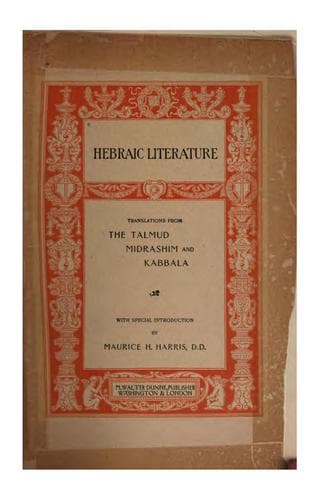
Hebraic Literature; Translations from the Talmud, Midrashim and Kabbala
Religion
Hebraic Literature; Translations from the Talmud, Midrashim and Kabbala
Hebrew literature -- Translations into English
Rabbi Zera said that the merit of having reached an extreme age was in
his case due, under Providence, to his conduct through life. He governed
his household with mildness and forbearance. He refrained from advancing
an opinion before his superiors in wisdom. He avoided rehearsing the
word of God in places not entirely free from uncleanliness. He wore the
phylacteries all day, that he might be reminded of his religious duties.
He did not make the college where sacred knowledge is taught, a place of
convenience, as, for instance, to sleep there, either occasionally or
habitually. He never rejoiced over the downfall of a fellow-mortal, nor
would he designate another by a name objectionable to the party
personally, or to the family of which he was a member.
* * * * *
"Three friends," said the Rabbis, "has man. God, his father, and his
mother. He who honors his parents honors God."
Rabbi Judah said, "Known and revealed are the ways of man. A mother
coaxes a child with kind words and gentle ways, gaining honor and
affection; therefore, the Bible says, 'Honor thy father,' before 'honor
thy mother.' But in regard to fearing, as the father is the preceptor of
the child, teaching it the law, the Bible says, 'Every man shall fear
his mother,' before the word 'father.'"
Rabbi Ulah was once asked, "How extended should be this honor due to
parents?"
He replied:--
"Listen, and I will tell ye how thoroughly it was observed by a heathen,
Damah, the son of Nethina. He was a diamond merchant, and the sages
desired to purchase from him a jewel for the ephod of the high priest.
When they reached his house, they found that the key of the safe in
which the diamond was kept was in the possession of Damah's father, who
was sleeping. The son absolutely refused to wake his father, to obtain
the key, even when the sages in their impatience offered him a much
larger sum for the jewel than he had demanded. And further, when his
father awoke, and he delivered the diamond to the purchasers, and they
offered him the larger sum which they had named, he took from it his
first price, returning the balance to them, with the words, 'I will not
profit by the honor of my father.'"
* * * * *
Man cannot always judge of man, and in the respect paid to parents by
their children, earthly eyes cannot always see the truth. For instance,
a child may feed his parents on dainties, and yet deserve the punishment
of a disrespectful son; while another may send his father to labor, and
yet deserve reward. How may this be?
A certain man placed dainty food before his father, and bade him eat
thereof. When the father had finished his meal, he said:--
"My son, thou hast prepared for me a most delicious meal. Wherefrom
didst thou obtain these delicacies?"
And the son replied, insultingly:--
"Eat as the dogs do, old man, without asking questions."
That son inherited the punishment of disrespect.
Public-domain text, read in full here on John Shaqi.
Reviews
Reviews
No reviews yet
Be the first to share your thoughts on this work.
Elsewhere in the archive
Join the Discussion
Join the discussion
Sign in to leave a comment or review.
Sign InorCreate an account