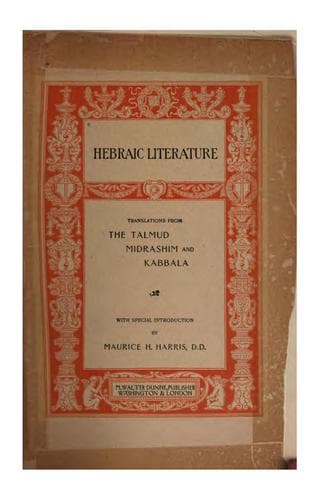
Hebraic Literature; Translations from the Talmud, Midrashim and Kabbala
Religion
Hebraic Literature; Translations from the Talmud, Midrashim and Kabbala
Hebrew literature -- Translations into English
"For that very reason I laugh, and am glad," answered Rabbi Akiba. "If
God allows those who transgress His will to live happily on earth, how
infinitely great must be the happiness which He has stored up in the
world to come for those who observe His commands."
Upon another occasion these same Rabbis went up to Jerusalem. When they
reached Mount Zophim and saw the desolation about them they rent their
garments, and when they reached the spot where the Temple had stood and
saw a fox run out from the very site of the holy of holies four of them
wept bitterly; but again Rabbi Akiba appeared merry. His comrades again
rebuked him for this, to them, unseemly state of feeling.
"Ye ask me why I am merry," said he; "come now, tell me why ye weep?"
"Because the Bible tells us that a stranger (one not descended from
Aaron) who approaches the holy of holies shall be put to death, and now
behold the foxes make of it a dwelling-place. Why should we not weep?"
"Ye weep," returned Akiba, "from the very reason which causes my heart
to be glad. Is it not written, 'And testify to me, ye faithful
witnesses, Uriah, the priest, and Zachariah, the son of Berachiahu?' Now
what hath Uriah to do with Zachariah? Uriah lived during the existence
of the first Temple, and Zachariah during the second. Know ye not that
the prophecy of Uriah is compared to the prophecy of Zachariah. From
Uriah's prophecy we find, 'Therefore for your sake Zion will be plowed
as is a field, and Jerusalem will be a desolation, and the mount of Zion
shall be as a forest;' and in Zachariah we find, 'They will sit, the old
men and women, in the streets of Jerusalem.' Before the prophecy of
Uriah was accomplished I might have doubted the truth of Zachariah's
comforting words; but now that one has been accomplished, I feel assured
that the promises to Zachariah will also come to pass, therefore am I
glad."
"Thy words comfort us, Akiba," answered his companions. "May God ever
provide us comfort."
Still another time, when Rabbi Eleazer was very sick and his friends and
scholars were weeping for him, Rabbi Akiba appeared happy, and asked
them why they wept. "Because," they replied, "our beloved Rabbi is lying
between life and death." "Weep not, on the contrary be glad therefor,"
he answered. "If his wine did not grow sour, if his flag was not
stricken down, I might think that on earth he received the reward of his
righteousness; but now that I see my teacher suffering for what evil he
may have committed in this world, I rejoice. He hath taught us that the
most righteous among us commit some sin, therefore in the world to come
he will have peace."
* * * * *
While Rabbi Eleazer was sick, the four elders, Rabbi Tarphon, Rabbi
Joshua, Rabbi Eleazer, the son of Azoria, and Rabbi Akiba, called upon
him.
Public-domain text, read in full here on John Shaqi.
Reviews
Reviews
No reviews yet
Be the first to share your thoughts on this work.
Elsewhere in the archive
Join the Discussion
Join the discussion
Sign in to leave a comment or review.
Sign InorCreate an account