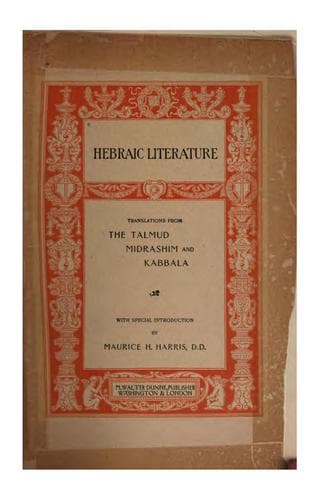
Hebraic Literature; Translations from the Talmud, Midrashim and Kabbala
Religion
Hebraic Literature; Translations from the Talmud, Midrashim and Kabbala
Hebrew literature -- Translations into English
A young man, upon his journeys through the country, fell in with a young
woman, and they became mutually attached. When the young man was obliged
to leave the neighborhood of the damsel's residence, they met to say
"good-by." During the parting they pledged a mutual faith, and each
promised to wait until, in the course of time, they might be able to
marry. "Who will be the witness of our betrothal?" said the young man.
Just then they saw a weasel run past them and disappear in the wood.
"See," he continued, "this weasel and this well of water by which we are
standing shall be the witnesses of our betrothal;" and so they parted.
Years passed, the maiden remained true, but the youth married. A son was
born to him, and grew up the delight of his parents. One day while the
child was playing he became tired, and lying upon the ground fell
asleep. A weasel bit him in the neck, and he bled to death. The parents
were consumed with grief by this calamity, and it was not until another
son was given them that they forgot their sorrow. But when this second
child was able to walk alone it wandered without the house, and bending
over the well, looking at its shadow in the water, lost its balance and
was drowned. Then the father recollected his perjured vow, and his
witnesses, the weasel and the well. He told his wife of the
circumstance, and she agreed to a divorce. He then sought the maiden to
whom he had promised marriage, and found her still awaiting his return.
He told her how, through God's agency, he had been punished for his
wrongdoing, after which they married and lived in peace.
* * * * *
A wise Israelite, dwelling some distance from Jerusalem, sent his son to
the Holy City to complete his education. During his son's absence the
father was taken ill, and feeling that death was upon him he made a
will, leaving all his property to one of his slaves, on condition that
he should allow the son to select any one article which pleased him for
an inheritance.
As soon as his master died, the slave, elated with his good fortune,
hastened to Jerusalem, informed his late master's son of what had taken
place, and showed him the will.
The young man was surprised and grieved at the intelligence, and after
the alloted time of mourning had expired, he began to seriously consider
his situation. He went to his teacher, explained the circumstances to
him, read him his father's will, and expressed himself bitterly on
account of the disappointment of his reasonable hopes and expectations.
He could think of nothing that he had done to offend his father, and was
loud in his complaints of injustice.
"Stop," said his teacher; "thy father was a man of wisdom and a loving
relative. This will is a living monument to his good sense and
far-sightedness. May his son prove as wise in his day."
"What!" exclaimed the young man. "I see no wisdom in his bestowal of his
property upon a slave; no affection in this slight upon his only son."
Public-domain text, read in full here on John Shaqi.
Reviews
Reviews
No reviews yet
Be the first to share your thoughts on this work.
Elsewhere in the archive
Join the Discussion
Join the discussion
Sign in to leave a comment or review.
Sign InorCreate an account