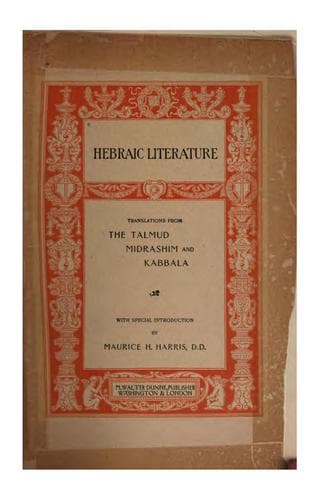
Hebraic Literature; Translations from the Talmud, Midrashim and Kabbala
Religion
Hebraic Literature; Translations from the Talmud, Midrashim and Kabbala
Hebrew literature -- Translations into English
A man was once traveling along the road and his son preceded him on the
way. A robber appeared in the path, and the man put his son behind him.
Then lo, a wolf came after the lad, and his father lifted him up and
carried him within his arms.
The sea was before the Israelites, the Egyptians were behind them, so
God lifted up His child and carried it within His arms.
When Israel suffered from the hot rays of the sun God "spread the cloud
for a covering;" when they were hungry He sent them bread from heaven;
and when they thirsted "He brought forth floods from a rock."
PENTECOST
The Feast of Weeks, or "Pentecost," occurs upon the sixth day of the
third month, _Sivan_ (June). It is called the Feast of Weeks because
forty-nine days, or seven weeks, duly numbered, elapse between the
second day of Passover, when (during the existence of the Temple) a
sheaf of green barley was offered, and this festival, when two loaves
made of the first flour of the wheat harvest were "brought before the
Lord." It is also the anniversary of the delivery of the commandment
from Mount Sinai.
Why does not the Bible particularize in this as on other occasions, and
say directly, "On the sixth day of the third month was the law given?"
Because in ancient times the men called "wise" placed their faith and
dependence upon the planets. They divided these into seven, apportioning
one to each day of the week. Some nations selected for their greatest
god the sun, other nations the moon, and so on, and prayed to them and
worshiped them. They knew not that the planets moved and changed
according to the course of nature, established by the Most High, a
course which He might change according to His will, and into their
ignorant ideas many of the Israelites had entered. Therefore, as they
considered the planets as seven, God made many other things depending on
that number, to show that as He made them, so had He made the planets.
The seventh day of the week He made the Sabbath; the seventh year he
made the year of rest; after seven times seven years, or after seven
Sabbatical years, He ordained the Jubilee, or year of release. Seven
days He gave to the Passover festival, and seven days to the Feast of
Tabernacles. Seven days was Jericho surrounded, and seven priests took
seven trumpets and marched round its walls seven times upon the seventh
day.
Therefore, after numbering seven weeks during the ripening time of the
grain, the Israelites were to hold a holy convocation, to praise the One
who can prevent all things, but who cannot be prevented; who can change
all things, but is unchangeable.
The first day the Israelites were redeemed from slavery and
superstition; the fiftieth day a law was given them for their guide
through life; therefore they are commanded to number these days and
remember them.
Public-domain text, read in full here on John Shaqi.
Reviews
Reviews
No reviews yet
Be the first to share your thoughts on this work.
Elsewhere in the archive
Join the Discussion
Join the discussion
Sign in to leave a comment or review.
Sign InorCreate an account