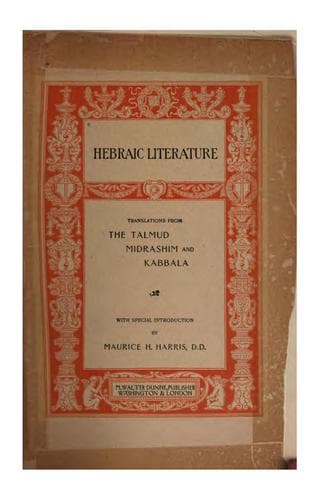
Hebraic Literature; Translations from the Talmud, Midrashim and Kabbala
Religion
Hebraic Literature; Translations from the Talmud, Midrashim and Kabbala
Hebrew literature -- Translations into English
During the year man is apt to grow callous as to his transgressions,
therefore the cornet is sounded to arouse him to the consciousness of
the time which is passing so rapidly away. "Rouse thee from thy sleep,"
it says to him; "the hour of thy visitation approaches." The Eternal
wishes not to destroy His children, merely to arouse them to repentance
and good resolves.
Three classes of people are arraigned for judgment: the righteous, the
wicked, and the indifferent. To the righteous the Lord awards a happy
life; the wicked He condemns, and to the indifferent ones He grants a
respite. From New Year's day until the Day of Atonement His judgment He
holds in abeyance; if they repent truly they are classed with the
righteous for a happy life, and if they remain untouched, they are
counted with the wicked.
Three sounds for the cornet are commanded in the Bible. A pure sound
(_T'kiah_), a sound of alarm or trembling (_T'ruah_), and, thirdly, a
pure sound again (_T'kiah_).
The first sound typifies man's first awakening to penitence; he must
search well his heart, desert his evil ways, and purify his thoughts, as
it is written, "Let the wicked forsake his ways and the man of
unrighteousness his thoughts, and let him return unto the Lord."
The alarm sound typifies the sorrow which a repentant man feels for his
misconduct and his earnest determination to reform.
The last sound is the pure sound again, which typifies a sincere resolve
to keep the repentant heart incorrupt.
The Bible says to us:--
"The word is very nigh unto thee, in thy mouth and in thy heart, that
thou mayest do it." This verse teaches us that repentance is nearer to
those who believe in God and His book than fanatics would make it.
Difficult penances are ordained for the sinner among them. He must fast
many days, or travel barefoot through rugged ways, or sleep in the open
air. But we are not required to travel to the nether end of the ocean or
to climb to mountain tops, for our Holy Word says to us, "It is not in
heaven, neither is it beyond the sea, but the Word is very nigh."
In three ways may we repent:--
First, By words of mouth, finding birth in an honest heart.
Secondly, With our feelings, sorrow for sins committed.
Thirdly, By good deeds in the future.
Rabbi Saadiah declared that God commanded us to sound the cornet on New
Year's day for ten reasons.
First, because this day is the beginning of the creation, when God began
to reign over the world, and as it is customary to sound the trumpets at
the coronation of a king, we should in like manner proclaim by the sound
of the cornet that the Creator is our king,--as David said, "With
trumpets and the sound of the cornet, shout ye before the Lord."
Public-domain text, read in full here on John Shaqi.
Reviews
Reviews
No reviews yet
Be the first to share your thoughts on this work.
Elsewhere in the archive
Join the Discussion
Join the discussion
Sign in to leave a comment or review.
Sign InorCreate an account