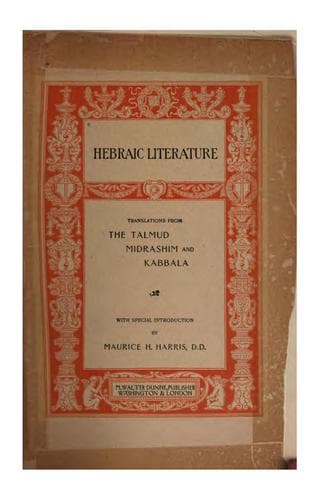
Hebraic Literature; Translations from the Talmud, Midrashim and Kabbala
Religion
Hebraic Literature; Translations from the Talmud, Midrashim and Kabbala
Hebrew literature -- Translations into English
First, the righteous man, who repents his misconduct as soon as he
becomes aware of his sin. This is the best and most complete.
Secondly, of the man who has for some time led a life of sin, yet who,
in the vigor of his days, gives over his evil ways and conquers his
wrong inclinations. As Solomon has said, "Remember thy Creator in the
days of thy youthful vigor." While in the prime of life abandon thy evil
ways.
Thirdly, of the one who was prevented by some cause from the commission
of a contemplated sin, and who truly repents his evil intention. "Happy
is the man who fears the Lord," said the Psalmist. The man, not the
woman? Aye, all mankind. The word is used to denote strength; those who
repent while still in their youth.
Fourthly, of the one who repents when his sin is pointed out to him, and
he is rebuked for the same, as in the instance of the inhabitants of
Nineveh. They repented not until Jonah proclaimed to them, "Yet forty
days more, and Nineveh shall be overthrown." The men of Nineveh believed
in God's mercy, and though the decree had been pronounced against them,
yet they repented. "And God saw their work, that they had returned from
their evil ways, and God bethought Himself of the evil which He had
spoken that He would do to them, and He did it not." Therefore say the
Rabbis, "Our brethren, neither sackcloth nor fasting will gain
forgiveness for sins; but repentance of the heart and good deeds; for it
is not said of the men of Nineveh, 'God saw their fasting and
sackcloth,' but 'God saw their work, that they had turned from their
evil ways.'"
Fifthly, of those who repent when trouble befalls them. How much nobler
is this than human nature! Instance Jephtah: "Did ye not hate me ... and
why are ye come unto me now when you are in distress?" But the infinite
mercy of our God accepts even such repentance; as it is written, "When
thou art in tribulation, and all these things have overtaken thee ...
then wilt thou return unto the Lord thy God." Founded upon this is the
proverb of the fathers, "Repentance and good deeds form a shield against
punishment."
Sixthly, the repentance of age. Even when man grows old and feeble, if
he repents truly, his atonement will be received. As the Psalmist says,
"Thou turnest man to contrition, and sayest, 'Return, ye children of
men.'" Meaning, man can return at any time or any age, "Return, ye
children of men."
Say the Rabbis, "Although a man has been righteous in his youth and
vigor, yet if he rebels against the will of God in his old age, the
merit of his former goodness shall be lost to him, as it is written,
'When a righteous man turns away from his righteousness and doeth wrong,
and dieth therefor; through his wrong which he hath done must he die.'
But a man who has been wicked in his early days, and feels true sorrow
and penitence in his old age, shall not be called 'wicked' any more.
This, however, is not gracious penitence when it is so long delayed."
Public-domain text, read in full here on John Shaqi.
Reviews
Reviews
No reviews yet
Be the first to share your thoughts on this work.
Elsewhere in the archive
Join the Discussion
Join the discussion
Sign in to leave a comment or review.
Sign InorCreate an account