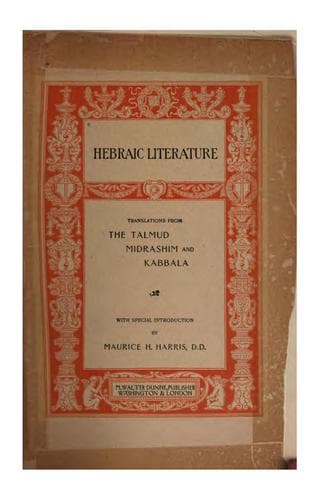
Hebraic Literature; Translations from the Talmud, Midrashim and Kabbala
Religion
Hebraic Literature; Translations from the Talmud, Midrashim and Kabbala
Hebrew literature -- Translations into English
These three complain, but no one sympathizes with them:--He who lends
money without witnesses; he who buys to himself a master; and he who is
lorded over by his wife.
Ibid., fol. 75, col. 2.
There are three things on which the world stands:--The law, the temple
service, and benevolence.
_Avoth_, chap. 1.
If three eat at one table and do not converse together on the law of the
Lord, it is as if they ate from the sacrifices for the dead; but they,
on the contrary, are as if they partook from a table of the Lord's own
furnishing who, while they sit down to meat, season their talk with its
holy precepts.
_Avoth_, chap. 3.
There are three crowns:--The crown of the law, the crown of the
priesthood, and the crown of royalty; but the crown of a good name
surpasses them all.
Ibid., chap. 4.
He who possesses these three virtues is a disciple of Abraham our
father, and he who possesses the three contrary vices is a son of Balaam
the wicked. The disciples of our father Abraham have a kindly eye, a
loyal spirit, and a lowly mind. The disciples of Balaam the wicked have
an evil eye, a proud spirit, and a grasping soul.
Ibid., chap. 5.
Three things are said respecting the children of men:--He who gives alms
brings a blessing on himself; he who lends does better; he who gives
away half of what he hath to spare does best of all.
_Avoth d'Rab. Nathan_, chap. 41.
There are three classes of disciples, and among them three grades of
worth:--He ranks first who asks and answers when asked; he who asks but
does not answer ranks next; but he who neither asks nor answers ranks
lowest of all.
Ibid.
Over these three does God weep every day:--Over him who is able to study
the law but neglects it; over him who studies it amid difficulties hard
to overcome; and over the ruler who behaves arrogantly toward the
community he should protect.
_Chaggigah_, fol. 5, col. 2.
Rabbi Yochanan says there are three keys in the hands of the Holy
One!--blessed be He!--which He never intrusts to the disposal of a
messenger, and they are these:--(1.) The key of rain, (2.) the key of
life, and (3.) the key of reviving the dead. The key of rain, for it is
written (Deut. xxviii. 12), "The Lord shall open unto thee His good
treasure, the heaven to give the rain unto thy land in season;" the key
of life, as it is written (Gen. xxx. 22), "God hearkened unto her, and
opened her womb;" the key of reviving the dead, for it is written (Ezek.
xxxvii. 13), "When I have opened your graves, and brought you up out of
your graves, and shall put my spirit in you, and ye shall live," etc.
_Taanith_, fol. 2, cols, 1, 2.
Public-domain text, read in full here on John Shaqi.
Reviews
Reviews
No reviews yet
Be the first to share your thoughts on this work.
Join the Discussion
Join the discussion
Sign in to leave a comment or review.
Sign InorCreate an account