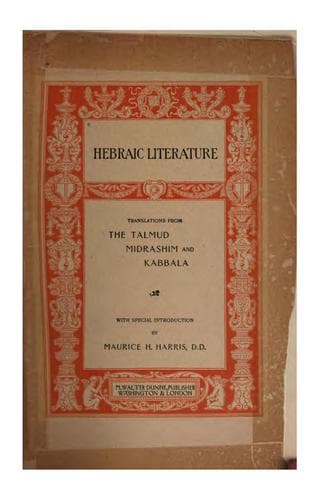
Hebraic Literature; Translations from the Talmud, Midrashim and Kabbala
Religion
Hebraic Literature; Translations from the Talmud, Midrashim and Kabbala
Hebrew literature -- Translations into English
There are four classes of men who give alms, and they are thus
distinguished:--He who is willing to give, but unwilling that others
should do so, he has an evil eye toward others; he who wishes others to
give, but does not do so himself, he has an evil eye toward himself; he
who gives, and induces others to give, he is pious; he who gives not,
nor wishes others to give he is wicked.
_Avoth_, chap 5, sec. 19.
There are four marks by which one disciple differs from another:--One
learns and does not teach, one teaches and does not learn, one learns
and teaches, and one neither learns nor teaches.
_Avoth d'Rab. Nathan_, chap. 29.
Four things, if kept in view and gravely pondered over, deter from
sin:--That a man consider whence he cometh, whither he goeth, who the
judge will be, and what the future will bring to pass.
_Derech Eretz_, chap. 3.
What is the meaning of that which is written (Ps. lxxxvii 2), "The Lord
loveth the gates of Zion more than all the dwellings of Jacob?" The
answer is, The Lord loveth the gates that are marked with the Halachah
more than the synagogues and the schools; and this agrees with what
Rabbi Cheeya bar Ami has said, in the name of Ulla, that since the
destruction of the Temple nothing else has remained to God in His world
but four ells of the Halachah.
_Berachoth_, fol. 8, col. 1.
Whoso walks even four ells with a proud unbending gait is as though he
spurned with his haughty head the feet of the Shechinah; for it is
written (Isa. vi. 3), "The whole earth is full of His glory."
Ibid., fol. 43, col. 2.
Four are in duty bound to return thanks to God:--They that have returned
from a voyage at sea (Ps. cvii. 23, 24, 31); those who have traveled in
the desert (verses 4-8); they who have recovered from a serious illness
(verses 17-21); and those that are liberated from prison (verses 10-15).
_Berachoth_, fol. 54, col. 2.
If one does not walk, say four cubits, before falling asleep after a
meal, that which he has eaten, being undigestible, causes foulness of
breath.
_Shabbath_, fol. 41, col. 1.
Four have died in consequence of the seduction of the
serpent:--Benjamin, the son of Jacob; Amram, the father of Moses; Jesse,
the father of David; and Chileab, the son of David.
Ibid., fol. 55, col. 2.
These four are reckoned to have died on account of original sin,
and not solely because of actual transgression, which, says
Rashi, they never committed.
The traveler who is overtaken with the approach of Sabbath-eve before he
has completed his journey should hand over his purse to a Gentile to
carry; and if there be no Gentile at hand, let him stow it away on his
ass. As soon as the nearest halting-place is reached, those burdens
which may be lifted on the Sabbath should then be removed, and then the
cords should be slackened that the rest may slip off of its own accord.
Ibid., fol. 153, col. 1.
Public-domain text, read in full here on John Shaqi.
Reviews
Reviews
No reviews yet
Be the first to share your thoughts on this work.
Elsewhere in the archive
Join the Discussion
Join the discussion
Sign in to leave a comment or review.
Sign InorCreate an account