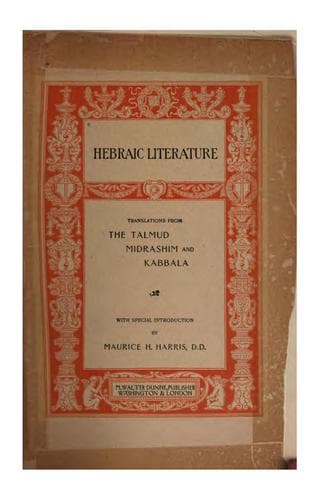
Hebraic Literature; Translations from the Talmud, Midrashim and Kabbala
Religion
Hebraic Literature; Translations from the Talmud, Midrashim and Kabbala
Hebrew literature -- Translations into English
Here the Gemara very graciously appends a direction as to the
disposal of the purse, in case the traveler should happen to be
on foot and have no Gentile attendant. He may take care of it
himself, provided he halt at every other step and deposit it on
the ground, for at least a distance of four cubits.
A master is bound to rehearse a lesson to his pupil four times.
_Eiruvin_, fol. 54, col. 2.
Alas for the power which prepares a grave for its possessor, for there
is not a prophet who hath not in his lifetime witnessed the decadence of
four kings; as it is said (Isa. i. 1), "The vision of Isaiah ... in the
days of Uzziah, Jotham, Ahaz, and Hezekiah, kings of Judah" (see also
Hosea i. 1).
_P'sachim_, fol. 87, col. 2.
Once Rav Pappa and Rav Hunnah partook together of a common meal, and as
the latter ate only one morsel the former ate four. After this, when Rav
Hunnah and Ravina ate together, the latter devoured eight portions to
the other's one, upon which Rav Hunnah jocularly remarked, "A hundred
(Rav) Pappas to one Ravina."
_P'sachim_, fol. 89, col. 2.
No food may be eaten on Passover-eve from the time of the offering of
the evening sacrifice (in order, i.e. that abstinence may whet the
appetite for the Matsoth). Even the poorest in Israel may not break his
fast till the hour of reclining; nor is he to partake of less than four
glasses of wine, even though he has been reduced so low as to subsist on
the porridge doled out by public charity.
Ibid., fol. 99, col. 2.
There are four things the doing of which by man brings judgment upon his
own head:--If he turn in between a wall and a date-palm; if he turn in
between two date-palms; if he drink borrowed water; and if he step
across spilt water, such even as his own wife may have thrown away. (All
these doings, says Rashi, are bound to annoy the evil genii.)
Ibid., fol. 111, col. 1.
Four precepts did our holy Rabbi (Yehudah Hakadosh) urge upon his
children:--Not to choose Shechentzia as a dwelling-place, for scoffers
resided there; not to use the bed of a Syrian odalisque; not to shirk
the payment of fiscal dues, lest the collector should confiscate all
their property; not to face an ox when he came up (ruffled) from the
cane-brake, for Satan sported betwixt his horns.
_P'sachim_, fol. 112, col. 2.
Whosoever prieth into the four things in the matter of the chariot in
Ezekiel's vision--what is above, what is beneath, what is before, or
what is behind--it were better for him if he had never been born.
_Chaggigah_, fol. 11, col. 2.
The work or matter of the chariot, the Rabbinic term for the
Vision of Ezekiel, ranks among the Arcana Judaica, which are not
to be told save to the initiated.
Public-domain text, read in full here on John Shaqi.
Reviews
Reviews
No reviews yet
Be the first to share your thoughts on this work.
Elsewhere in the archive
Join the Discussion
Join the discussion
Sign in to leave a comment or review.
Sign InorCreate an account