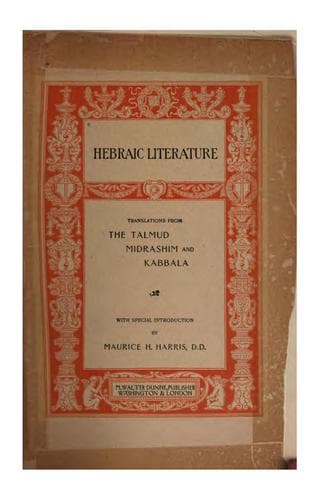
Hebraic Literature; Translations from the Talmud, Midrashim and Kabbala
Religion
Hebraic Literature; Translations from the Talmud, Midrashim and Kabbala
Hebrew literature -- Translations into English
For four reasons does their property pass out of the hands of the
avaricious:--Because they are backward in paying the wages of their
hired servants; because they altogether neglect their welfare; because
they shift the yoke from themselves and lay the burden upon their
neighbors; and because of pride, which is of itself as bad as all the
rest put together; whereas of the meek it is written (Ps. xxxvii. n),
"The meek shall inherit the earth."
_Succah_, fol. 29, col. 2.
"And the Lord showed me four carpenters" (Zech. i, 20). Who are these
four carpenters? Rav Ghana bar Bizna says that Rabbi Shimon Chassida
said they were Messiah the son of David, Messiah the son of Joseph,
Elijah, and the Priest of Righteousness.
Ibid., fol. 52, col. 2.
No Synagogue is to be sold except on condition that there be power of
re-purchase. These are the words of Rabbi Meir; but the sages say it may
be sold unconditionally, except in these four particular cases: that it
be not turned into a bath-house, a tannery, a wash-house, or a laundry.
_Meggillah_, fol. 27, col. 2.
Rabbi Yochanan ben Zachai was once asked by his disciples how he had
attained such length of days. "Never once," he said, "in my life have I
acted irreverently within four cubits of a place where prayer is
offered; never have I called a person by a wicked name; nor have I ever
failed to sanctify the Sabbath over a cup of wine. Once my aged mother
sold her head-dress to buy the consecration wine for me."
Ibid., fol. 27, col. 2.
When a sage is approaching, one should rise up before he gets within
four ells' distance, and remain standing until he has gone as far past.
When a chief magistrate is about to pass, one must rise as soon as he
comes in sight, and not resume the seat until he has passed four ells.
When a prince passes, one must stand up whenever he appears, and not sit
down again until the prince himself is seated; for it is said (Exod.
xxxiii, 8), "All the people rose up, ... and looked after Moses until he
was gone into the tabernacle."
_Kiddushin_, fol. 33, col. 2.
When Nero came to the Holy Land, he tried his fortune by belemnomancy
thus:--He shot an arrow eastward, and it fell upon Jerusalem; he
discharged his shafts towards the four points of the compass, and every
time they fell upon Jerusalem. After this he met a Jewish boy, and said
unto him, "Repeat to me the text thou hast learned to-day." The boy
repeated, "I will lay my vengeance upon Edom (i.e., Rome) by the hand of
my people Israel" (Ezek. xxv. 14). Then said Nero, "The Holy
One--blessed be He!--has determined to destroy His Temple and then
avenge Himself on the agent by whom its ruin is wrought." Thereupon Nero
fled and became a Jewish proselyte, and Rabbi Meir is of his race.
_Gittin_, fol. 56, col. 1.
Public-domain text, read in full here on John Shaqi.
Reviews
Reviews
No reviews yet
Be the first to share your thoughts on this work.
Elsewhere in the archive
Join the Discussion
Join the discussion
Sign in to leave a comment or review.
Sign InorCreate an account