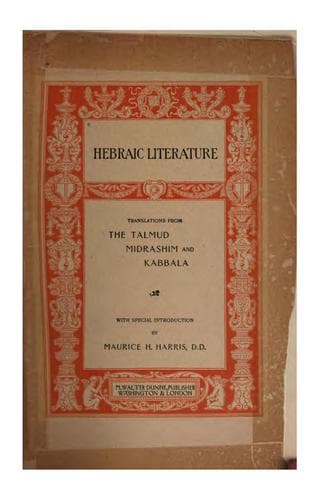
Hebraic Literature; Translations from the Talmud, Midrashim and Kabbala
Religion
Hebraic Literature; Translations from the Talmud, Midrashim and Kabbala
Hebrew literature -- Translations into English
Four men entered Paradise--these are their names:--Ben Azai, Ben Zoma,
Acher, and Rabbi Akiva. Rabbi Akiva thus warned his companions: "When
you come across pavements of pellucid marble, do not cry out 'Water!
water!' for it is said (Ps. ci. 7), 'He that uttereth falsehood shall
not dwell in my sight.'" Ben Azai looked and died; concerning him the
Scripture says (Ps. cxvi. 15), "Precious in the sight of the Lord is the
death of his saints." Ben Zoma looked and went out of his mind; of him
the Scripture says (Prov. xxv. 16), "Hast thou found honey? eat only so
much as is sufficient for thee, lest thou be filled therewith and vomit
it." Acher cut the plants. Only Akiva departed in peace.
_Chaggigah_, fol. 14, col. 2.
Rashi explains this by saying these men went up to heaven; but
Maimonides much more rationally teaches that the Paradise or
garden here is merely the retreat of profound philosophic
meditation. These five intuitions were;--(1.) To know that there
is a God; (2.) to ignore every other beside Him; (3.) to feel
His unity; (4.) to love His person; and (5.) to stand in awe of
His Majesty (see Vad Hachaz, chap. 4, sec. 19). Deep thought in
these matters was spoken of by the Rabbis as _promenading in the
garden_.
Four times a year is the world subject to an ordeal of judgment:--At
Passover, which is decisive of the fruits of the field; at Pentecost,
which is decisive of the fruits of the garden; at the feast of
Tabernacles, which is decisive in respect of rain; on New Year's Day,
when all who come into the world pass before the Lord like sheep, as it
is said (Ps. xxxiii. 15), "Who formed their hearts together; who
understandeth all their works."
_Rosh Hashanah_, fol. 16, col. 1.
There are four varieties of cedar:--Erez, Karthom, Etz-Shemen, and
Berosh.
Ibid., fol. 23, col. 1.
Ben Kamzar would not teach the art of writing, and yet it is related of
him that he could, by taking four pens between his fingers, write off a
word of four letters at one stroke.
_Yoma_, fol. 38, col. 2.
There are four kinds of quails:--Sichli, Kibli, Pisyoni, and the common
quail. The first was of superior quality, and the last inferior.
Ibid., fol. 75, col. 2.
A man may obtain forgiveness after the third transgression, but if he
repeat the offense a fourth time, he is not pardoned again; for it is
said (Amos ii. 4), "For three transgressions of Judah, and for four, I
will not turn away the punishment thereof;" and again (Job xxxiii. 29),
"Lo! all these things doth God two or three times" (and so inferentially
not four times) "with man to bring back his soul from the pit."
_Yoma_, fol. 86, col. 2.
Public-domain text, read in full here on John Shaqi.
Reviews
Reviews
No reviews yet
Be the first to share your thoughts on this work.
Elsewhere in the archive
Join the Discussion
Join the discussion
Sign in to leave a comment or review.
Sign InorCreate an account