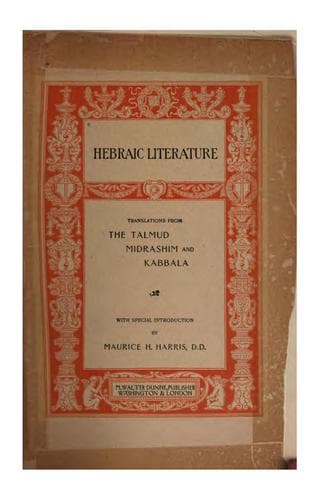
Hebraic Literature; Translations from the Talmud, Midrashim and Kabbala
Religion
Hebraic Literature; Translations from the Talmud, Midrashim and Kabbala
Hebrew literature -- Translations into English
How is it that the word signifying "And I will be glorified," occurs in
Hag. i. 8 without the letter which is the symbol for five, though it is
sounded as if that letter was there? It indicates the absence of five
things from the second Temple which were to be found in the first, (1.)
The ark, i.e., the mercy-seat of the cherubim; (2.) the fire from heaven
upon the altar; (3.) the visible presence; (4.) the Holy Spirit (of
prophecy, says Rashi); and (5.) the Urim and Thummim.
Ibid.
How then, it may be asked, if these five tokens of the Divine
presence and favor which rendered the first Temple so glorious
were wanting in the second could it be said (Hag. ii. 9), "The
glory of this latter house shall be greater than of the former"?
It is a question which it is natural to ask, and it should be
ingenuously answered. Is it that these were tending to usurp the
place of the spiritual, of which they were but the assurance and
the symbol, and darken rather than reveal the eternal reality
they adumbrated?
The Israelites relished any flavor they fancied in the manna except the
flavor of these five things (mentioned in Num. xi. 59):--"Cucumbers,
melons, leeks, onions, and garlic."
_Yoma_, fol. 75, col. 1.
Five things happened to our forefathers on the 17th of Tammuz, and five
on the 9th of Ab. On the 17th of Tammuz (1.) the tables of the covenant
were broken; (2.) the daily sacrifice was done away with; (3.) the city
walls were cleft asunder; (4.) Apostumes burned the roll of the law;
(5.) and set up an idol in the temple. On the 9th of Ab (1.) the decree
was uttered that our ancestors should not enter the land of Canaan; both
the (2.) first and the (3.) second Temple were destroyed; (4.) Byther
was subjugated and (5.) the city was plowed up.
_Taanith_, fol. 26, cols, 1, 2.
The Rabbis have taught where it is we learn that if one has five sons by
five wives he is bound to redeem each and all of them. It is from what
is taught in Exod. xxxiv. 20, where it is said, "All the first born of
thy sons shalt thou redeem."
_Kiddushin_. fol. 29. col. 2.
If Israel had not sinned they would have had no other Scriptures than
the five-fifths of the law (that is, the Pentateuch) and the book of
Joshua, which last is indispensable, because therein is recorded how the
land was distributed among the sons of Israel; but the remainder was
added, "Because in much wisdom is much grief" (Eccles. i. 18).
_Nedarim_, fol. 22, col. 2.
"If a man steal an ox or a sheep and kill it or sell it, five oxen shall
be given in restitution for one ox, and four sheep for one sheep" (Exod.
xxii. 1). From this observe the value put upon work. For the loss of an
ox, because it involves the loss of labor, the owner is recompensed with
five oxen; but for the loss of a sheep, which does no work, he is only
recompensed with four.
_Bava Kama_, fol. 79, col. 2.
Public-domain text, read in full here on John Shaqi.
Reviews
Reviews
No reviews yet
Be the first to share your thoughts on this work.
Elsewhere in the archive
Join the Discussion
Join the discussion
Sign in to leave a comment or review.
Sign InorCreate an account