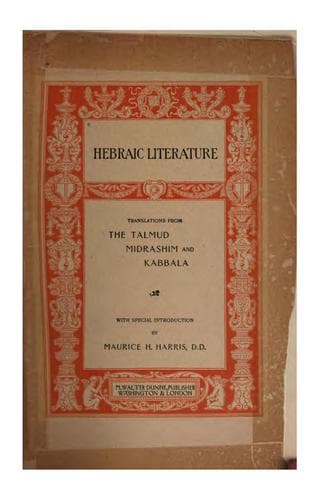
Hebraic Literature; Translations from the Talmud, Midrashim and Kabbala
Religion
Hebraic Literature; Translations from the Talmud, Midrashim and Kabbala
Hebrew literature -- Translations into English
Five have no forgiveness of sins:--(1.) He who keeps on sinning and
repenting alternately; (2.) he who sins in a sinless age; (3.) he who
sins on purpose to repent; (4.) he who causes the name of God to be
blasphemed. The fifth is not given in the Talmud.
Ibid., chap. 39.
He who has no fringes to his garment transgresses five positive commands
(see Num. xv. 38. etc.; Deut. xxii. 12).
_Menachoth_, fol. 44, col. 1.
A learner who, after five years, sees no profit in studying, will never
see it. Rabbi Yossi says, after three years, as it is written (Dan. i.
4, 5), "That they should be taught the literature and the language of
the Chaldeans," so educating them in three years.
_Chullin_, fol. 24, col. 1.
Any one who doeth any of these things sinneth against himself, and his
blood is upon his own head:--He that (1.) eats garlic, onions, or eggs
which were peeled the night before; (2.) or drinks water drawn over
night; (3.) or sleeps all night in a burying-place; (4.) or pares his
nails and throws the cuttings into the public street.
_Niddah_, fol. 17, col. 1.
Rabbi Yossi said:--"Never once in all my life have the walls of my house
seen the hem of my shirt; and I have planted five cedars (sons are
figuratively so termed, see Ps. xcii. 12) in Israel--namely, Rabbis
Ishmael, Eliezar, Chalafta, Artilas, and Menachem. Never once in my life
have I spoken of my wife by any other name than house, and of my ox by
any other name than field."
_Shabbath_, fol. 118, col. 2.
Six things are a disgrace to a disciple of the wise:--To walk abroad
perfumed, to walk alone by night, to wear old clouted shoes, to talk
with a woman in the street, to sit at table with illiterate men, and to
be late at the synagogue. Some add to these, walking with a proud step
or a haughty gait.
_Berachoth_, fol. 43, col. 2.
A soft-boiled egg is better than six ounces of fine flour.
Ibid., fol. 44, col. 2.
Six things are a certain cure for sickness:--Cabbage, beetroot, water
distilled from dry moss, honey, the maw and the matrix of an animal, and
the edge of the liver.
Ibid.
These six things are good symptoms in an invalid:--Sneezing,
perspiration, evacuation, seminal emission, sleep, and dreaming.
Ibid., fol. 57, col. 2.
Six things bear interest in this world and the capital remaineth in the
world to come:--Hospitality to strangers, visiting the sick, meditation
in prayer, early attendance at the school of instruction, the training
of sons to the study of the law, and judging charitably of one's
neighbors.
_Shabbath_, fol. 127, col. 1.
There are six sorts of tears, three good and three bad:--Those caused by
smoke, or grief, or constipation are bad; and those caused by fragrant
spices, laughter, and aromatic herbs are good.
Ibid., fol. 151, col. 2; fol. 152, col. 1.
Public-domain text, read in full here on John Shaqi.
Reviews
Reviews
No reviews yet
Be the first to share your thoughts on this work.
Elsewhere in the archive
Join the Discussion
Join the discussion
Sign in to leave a comment or review.
Sign InorCreate an account