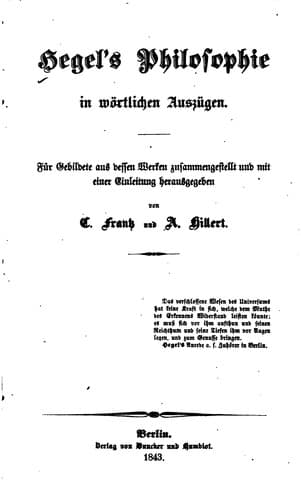
Hegel's Lectures on the History of Philosophy: Volume 3 (of 3)Hegel, Georg Wilhelm Friedrich
PhilosophyPhilosophy
Hegel's Lectures on the History of Philosophy: Volume 3 (of 3)
Hegel, Georg Wilhelm Friedrich
Philosophy -- History
It was in the Lutheran Reformation that the great revolution appeared,
as, after the eternal conflicts and the terrible discipline which the
stiff-necked Germanic character had undergone and which it had to
undergo, mind came to the consciousness of reconciliation with itself,
a reconciliation whose form required that it should be brought about
within the mind. From the Beyond man was thus called into the presence
of spirit, as earth and her bodily objects, human virtues and morality,
the individual heart and conscience, began to have some value to him. In
the church, if marriage was not held to be immoral, self-restraint and
celibacy were considered higher, but now marriage came to be looked on as
a divine institution. Then poverty was esteemed better than possession,
and to live on alms was considered higher than to support oneself
honestly by the work of one’s hands; now, however, it becomes known that
poverty is not the most moral life, for this last consists in living by
one’s work and taking pleasure in the fruits thereof. The blind obedience
by which human freedom was suppressed, was the third vow taken by the
monks, as against which freedom, like marriage and property, was now also
recognized as divine. Similarly on the side of knowledge man turned back
into himself from the Beyond of authority; and reason was recognized
as the absolutely universal, and hence as divine. Now it was perceived
that it is in the mind of man that religion must have its place, and
the whole process of salvation be gone through—that man’s salvation is
his own affair, and that by it he enters into relationship with his
conscience and into immediate connection with God, requiring no mediation
of priests having the so-called means of grace within their hands. There
is indeed a mediation present still by means of doctrine, perception, the
observation of self and of one’s actions; but that is a mediation without
a separating wall, while formerly a brazen wall of division was present
separating the laity from the church. It is thus the spirit of God that
must dwell within the heart of man, and this indwelling spirit must
operate in him.
Public-domain text, read in full here on John Shaqi.
Reviews
Reviews
No reviews yet
Be the first to share your thoughts on this work.
Elsewhere in the archive
Join the Discussion
Join the discussion
Sign in to leave a comment or review.
Sign InorCreate an account