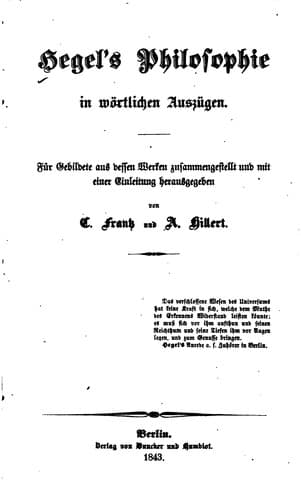
Hegel's Lectures on the History of Philosophy: Volume 3 (of 3)Hegel, Georg Wilhelm Friedrich
PhilosophyPhilosophy
Hegel's Lectures on the History of Philosophy: Volume 3 (of 3)
Hegel, Georg Wilhelm Friedrich
Philosophy -- History
the world. Knowledge of the world he possessed in the highest degree:
“rich imagination, powerful wit, and the penetrating wisdom which he
displays upon that most interesting of all subjects, commonly called
the world. This last appears to us to have been the characteristical
quality of Bacon’s genius.... It was men rather than things that he
had studied, the mistakes of philosophers rather than the errors of
philosophy. In fact he was no lover of abstract reasoning,” and although
it pertains to philosophy, we find as little as possible of it in him.
“His writings are indeed full of refined and most acute observations, but
it seldom requires any effort on our part to apprehend their wisdom.”
Hence mottoes are often derived from him. “His judgments,” however,
“are commonly given _ex cathedra_, or, if he endeavours to elucidate
them, it is by similes and illustrations and pointed animadversions
more than by direct and appropriate arguments. General reasoning is
absolutely essential in philosophy; the want of it is marked in Bacon’s
writings.”[96] His practical writings are specially interesting; but we
do not find the bright flashes of genius that we expected. As during
his career in the state he acted in accordance with practical utility,
he now, at its conclusion, likewise applied himself in a practical
way to scientific endeavours, and considered and treated the sciences
in accordance with concrete experience and investigation. His is a
consideration of the present, he makes the most of, and ascribes value to
it as it appears; the existent is thus regarded with open eyes, respect
is paid to it as to what reigns pre-eminent, and this sensuous perception
is reverenced and recognized. Here a confidence on the part of reason
in itself and in nature is awakened; it thinkingly applies itself to
nature, certain of finding the truth in it, since both are in themselves
harmonious.
Public-domain text, read in full here on John Shaqi.
Reviews
Reviews
No reviews yet
Be the first to share your thoughts on this work.
Elsewhere in the archive
Join the Discussion
Join the discussion
Sign in to leave a comment or review.
Sign InorCreate an account