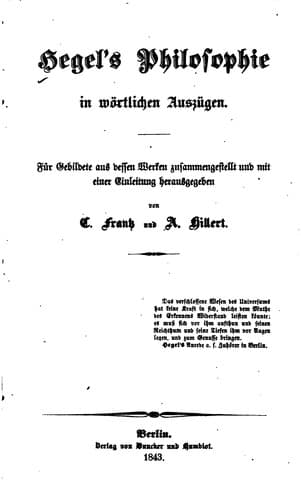
Hegel's Lectures on the History of Philosophy: Volume 3 (of 3)Hegel, Georg Wilhelm Friedrich
PhilosophyPhilosophy
Hegel's Lectures on the History of Philosophy: Volume 3 (of 3)
Hegel, Georg Wilhelm Friedrich
Philosophy -- History
The proof of the existence of God from the Idea of Him is in this wise:
In this Notion existence is implied; and therefore it is true. Descartes
proceeds further in the same direction, in so far as after the manner
of empirical axioms he sets forth: (α) “There are different degrees of
reality or entity, for the substance has more reality than the accident
or the mode, and infinite substance has more than finite.” (β) “In the
Notion of a thing existence is implied, either the merely potential
or the necessary,” _i.e._ in the ‘I’ there is Being as the immediate
certainty of an other-being, of the not-I opposed to the I. (γ) “No
thing or no perfection of a thing which really exists _actu_ can have
the Nothing as original cause of its existence. For if anything could
be predicated of nothing, thought could equally well be predicated of
it, and I would thus say that I am nothing because I think.” Descartes
here arrives at a dividing line, at an unknown relationship; the Notion
of cause is reached, and this is a thought indeed, but a determinate
thought. Spinoza says in his explanation, “That the conceptions contain
more or less reality, and those moments have just as much evidence as
thought itself, because they not only say that we think, but how we
think.” These determinate modes as differences in the simplicity of
thought, had, however, to be demonstrated. Spinoza adds to this step in
advance that “The degrees of reality which we perceive in ideas are not
in the ideas in as far as they are considered merely as kinds of thought,
but in so far as the one represents a substance and the other a mere
mode of substance, or, in a word, in so far as they are considered as
conceptions of things.” (δ) “The objective reality of Notions” (_i.e._,
the entity of what is represented in so far as it is in the Notion),
“demands a first cause in which the same reality is contained not merely
objectively” (that is to say in the Notion), “but likewise formally or
even _eminenter_—formally, that is perfectly likewise: _eminenter_, more
perfectly. For there must at least be as much in the cause as in the
effect.” (ε) “The existence of God is known immediately”—_a priori_—“from
the contemplation of His nature. To say that anything is contained in
the nature or in the Notion of a thing is tantamount to saying that it
is true: existence is directly contained in the Notion of God. Hence
it is quite true to say of Him that existence pertains of necessity to
Him. There is implied in the Notion of every particular thing either a
possible or a necessary existence—a necessary existence in the Notion
of God, _i.e._ of the absolutely perfect Being, for else He would be
conceived as imperfect.”[172]
Public-domain text, read in full here on John Shaqi.
Reviews
Reviews
No reviews yet
Be the first to share your thoughts on this work.
Elsewhere in the archive
Join the Discussion
Join the discussion
Sign in to leave a comment or review.
Sign InorCreate an account