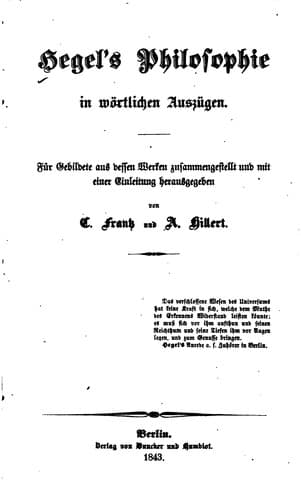
Hegel's Lectures on the History of Philosophy: Volume 3 (of 3)Hegel, Georg Wilhelm Friedrich
PhilosophyPhilosophy
Hegel's Lectures on the History of Philosophy: Volume 3 (of 3)
Hegel, Georg Wilhelm Friedrich
Philosophy -- History
Taken as a whole, this constitutes the Idea of Spinoza, and it is
just what τὸ ὄν was to the Eleatics (Vol. I. pp. 244, 252). This Idea
of Spinoza’s we must allow to be in the main true and well-grounded;
absolute substance is the truth, but it is not the whole truth; in
order to be this it must also be thought of as in itself active and
living, and by that very means it must determine itself as mind. But
substance with Spinoza is only the universal and consequently the
abstract determination of mind; it may undoubtedly be said that this
thought is the foundation of all true views—not, however, as their
absolutely fixed and permanent basis, but as the abstract unity which
mind is in itself. It is therefore worthy of note that thought must
begin by placing itself at the standpoint of Spinozism; to be a follower
of Spinoza is the essential commencement of all Philosophy. For as we
saw above (Vol I. p. 144), when man begins to philosophize, the soul
must commence by bathing in this ether of the One Substance, in which
all that man has held as true has disappeared; this negation of all
that is particular, to which every philosopher must have come, is the
liberation of the mind and its absolute foundation. The difference
between our standpoint and that of the Eleatic philosophy is only this,
that through the agency of Christianity concrete individuality is in the
modern world present throughout in spirit. But in spite of the infinite
demands on the part of the concrete, substance with Spinoza is not yet
determined as in itself concrete. As the concrete is thus not present in
the content of substance, it is therefore to be found within reflecting
thought alone, and it is only from the endless oppositions of this last
that the required unity emerges. Of substance as such there is nothing
more to be said; all that we can do is to speak of the different ways
in which Philosophy has dealt with it, and the opposites which in it
are abrogated. The difference depends on the nature of the opposites
which are held to be abrogated in substance. Spinoza is far from having
proved this unity as convincingly as was done by the ancients; but what
constitutes the grandeur of Spinoza’s manner of thought is that he is
able to renounce all that is determinate and particular, and restrict
himself to the One, giving heed to this alone.
1. Spinoza begins (Eth. P. I pp. 35, 36) with a series of definitions,
from which we take the following.
Public-domain text, read in full here on John Shaqi.
Reviews
Reviews
No reviews yet
Be the first to share your thoughts on this work.
Elsewhere in the archive
Join the Discussion
Join the discussion
Sign in to leave a comment or review.
Sign InorCreate an account