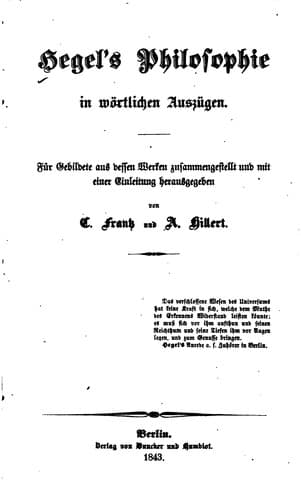
Hegel's Lectures on the History of Philosophy: Volume 3 (of 3)Hegel, Georg Wilhelm Friedrich
PhilosophyPhilosophy
Hegel's Lectures on the History of Philosophy: Volume 3 (of 3)
Hegel, Georg Wilhelm Friedrich
Philosophy -- History
He is then absolute power in contrast to wisdom, which
sets up definite aims, and consequently limitations; particular aims,
thoughts of what is about to come to pass, and the like are therefore put
out of the question. But beyond this universal, no advance is made; for
it must be noticed as specially singular, that Spinoza in the fiftieth
Letter (Oper. T. I. p. 634) says that every determination is a negation.
Moreover, if God is the cause of the world, it is implied that He is
finite; for the world is here put beside God as something different from
Him.
b. The greatest difficulty in Spinoza is, in the distinctions to which
he comes, to grasp the relation of this determinate to God, at the same
time preserving the determination. “God is a thinking Being, because all
individual thoughts are modes which express God’s nature in a certain
and determinate manner; there pertains therefore to God an attribute the
conception of which all individual thoughts involve, and by means of this
they also are conceived. God is an extended Being for the same reason.”
This means that the same substance, under the attribute of thought, is
the intelligible world, and under the attribute of extension, is nature;
nature and thought thus both express the same Essence of God. Or, as
Spinoza says, “The order and system of natural things is the same as
the order of the thoughts. Thus, for instance, the circle which exists
in nature, and the idea of the existing circle, which is also in God,
are one and the same thing” (they are one and the same content), “which
is” merely “expressed by means of different attributes. If we therefore
regard nature either under the attribute of extension or of thought,
or under any other attribute whatever, we shall find one and the same
connection of causes, _i.e._, the same sequence of things. The formal
Being of the idea of the circle can be conceived only by means of the
mode of thought, as its proximate cause, and this mode again by means of
another, and so on infinitely; so that we must explain the order of the
whole of nature, or the connection of causes, by the attribute of thought
alone, and if things are considered by the attribute of extension, they
must be considered only by the attribute of extension,—and the same holds
good of other causes.”[198] It is one and the same system, which at one
time appears as nature, and at another time in the form of thought.
Public-domain text, read in full here on John Shaqi.
Reviews
Reviews
No reviews yet
Be the first to share your thoughts on this work.
Elsewhere in the archive
Join the Discussion
Join the discussion
Sign in to leave a comment or review.
Sign InorCreate an account