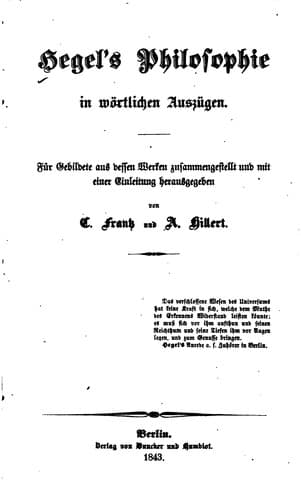
Hegel's Lectures on the History of Philosophy: Volume 3 (of 3)Hegel, Georg Wilhelm Friedrich
PhilosophyPhilosophy
Hegel's Lectures on the History of Philosophy: Volume 3 (of 3)
Hegel, Georg Wilhelm Friedrich
Philosophy -- History
preserve distinctions.
Spinoza goes on to say: “What constitutes the real (_actuale_) existence
of the human mind is nothing else than the idea of a particular”
(individual) “thing, that actually exists,” not of an infinite thing.
“The essence of man involves no necessary existence, _i.e._ according
to the order of nature a man may just as well be as not be.” For the
human consciousness, as it does not belong to essence as an attribute,
is a mode—a mode of the attribute of thought. But neither is the body,
according to Spinoza, the cause of consciousness, nor is consciousness
the cause of the body, but the finite cause is here only the relation
of like to like; body is determined by body, conception by conception.
“The body can neither determine the mind to thought, nor can the mind
determine the body to motion, or rest, or anything else. For all modes
of thought have God as Cause, in so far as He is a thinking thing, and
not in so far as He is revealed by means of another attribute. What
therefore determines the mind to thought, is a mode of thought and not
of extension; similarly motion and rest of the body must be derived from
another body.”[203] I might quote many other such particular propositions
from Spinoza, but they are very formal, and a continual repetition of one
and the same thing.
Buhle (Gesch. d. neuern Phil. Vol. III. Section 2, pp. 525-528),
attributes limited conceptions to Spinoza: “The soul experiences in the
body all the ‘other’ of which it becomes aware as outside of the body,
and it becomes aware of this ‘other’ only by means of the conceptions
of the qualities which the body perceives therein. If, therefore, the
body can perceive no qualities of a thing, the soul also can come to
no knowledge of it. On the other hand, the soul is equally unable to
arrive at the perception of the body which belongs to it; the soul knows
not that the body is there, and knows itself even in no other way than
by means of the qualities which the body perceives in things which are
outside of it, and by means of the conceptions of the same. For the
body is an individual thing, determined in a certain manner, which can
only gradually, in association with and amidst other individual things,
attain to existence, and can preserve itself in existence only as thus
connected, combined and associated with others,” _i.e._ in infinite
progress; the body can by no means be conceived from itself. “The soul’s
consciousness expresses a certain determinate form of a Notion, as the
Notion itself expresses a determinate form of an individual thing. But
the individual thing, its Notion, and the Notion of this Notion are
altogether and entirely one and the same thing, only regarded under
different attributes. As the soul is nothing else than the immediate
Notion of the body, and is one and the same thing with this, the
excellence of the soul can never be anything else than the excellence
of the body. The capacities of the understanding are nothing but the
Public-domain text, read in full here on John Shaqi.
Reviews
Reviews
No reviews yet
Be the first to share your thoughts on this work.
Elsewhere in the archive
Join the Discussion
Join the discussion
Sign in to leave a comment or review.
Sign InorCreate an account