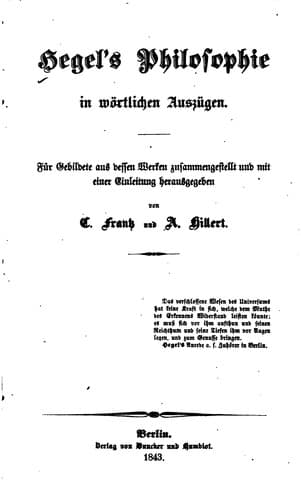
Hegel's Lectures on the History of Philosophy: Volume 3 (of 3)Hegel, Georg Wilhelm Friedrich
PhilosophyPhilosophy
Hegel's Lectures on the History of Philosophy: Volume 3 (of 3)
Hegel, Georg Wilhelm Friedrich
Philosophy -- History
Spinoza maintains that there is no such thing as
what is known as the world; it is merely a form of God, and in and for
itself it is nothing. The world has no true reality, and all this that
we know as the world has been cast into the abyss of the one identity.
There is therefore no such thing as finite reality, it has no truth
whatever; according to Spinoza what is, is God, and God alone. Therefore
the allegations of those who accuse Spinoza of atheism are the direct
opposite of the truth; with him there is too much God. They say: If
God is the identity of mind and nature, then nature or the individual
man is God. This is quite correct, but they forget that nature and the
individual disappear in this same identity: and they cannot forgive
Spinoza for thus annihilating them. Those who defame him in such a way
as this are therefore not aiming at maintaining God, but at maintaining
the finite and the worldly; they do not fancy their own extinction and
that of the world. Spinoza’s system is absolute pantheism and monotheism
elevated into thought. Spinozism is therefore very far removed from being
atheism in the ordinary sense; but in the sense that God is not conceived
as spirit, it is atheism. However, in the same way many theologians are
also atheists who speak of God only as the Almighty Supreme Being, etc.,
who refuse to acknowledge God, and who admit the validity and truth of
the finite. They are many degrees worse than Spinoza.
The second point to be considered is the method adopted by Spinoza for
setting forth his philosophy; it is the demonstrative method of geometry
as employed by Euclid, in which we find definitions, explanations,
axioms, and theorems. Even Descartes made it his starting-point that
philosophic propositions must be mathematically handled and proved, that
they must have the very same evidence as mathematics. The mathematical
method is considered superior to all others, on account of the nature
of its evidence; and it is natural that independent knowledge in its
re-awakening lighted first upon this form, of which it saw so brilliant
an example. The mathematical method is, however, ill-adapted for
speculative content, and finds its proper place only in the finite
sciences of the understanding. In modern times Jacobi has asserted
(Werke, Vol. IV. Section I. pp. 217-223) that all demonstration, all
scientific knowledge leads back to Spinozism, which alone is a logical
method of thought; and because it must lead thither, it is really of
no service whatever, but immediate knowledge is what we must depend on.
It may be conceded to Jacobi that the method of demonstration leads
to Spinozism, if we understand thereby merely the method of knowledge
belonging to the understanding. But the fact is that Spinoza is made a
testing-point in modern philosophy, so that it may really be said: You
are either a Spinozist or not a philosopher at all. This being so, the
mathematical and demonstrative method of Spinoza would seem to be only
Public-domain text, read in full here on John Shaqi.
Reviews
Reviews
No reviews yet
Be the first to share your thoughts on this work.
Elsewhere in the archive
Join the Discussion
Join the discussion
Sign in to leave a comment or review.
Sign InorCreate an account