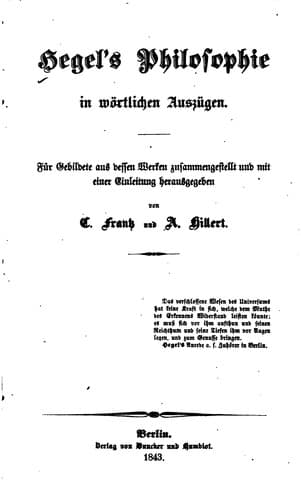
Hegel's Lectures on the History of Philosophy: Volume 3 (of 3)Hegel, Georg Wilhelm Friedrich
PhilosophyPhilosophy
Hegel's Lectures on the History of Philosophy: Volume 3 (of 3)
Hegel, Georg Wilhelm Friedrich
Philosophy -- History
no “healthy human understanding” in such procedure of the Scholastics;
the former cannot oppose itself to speculation, but it can very well
take up a position hostile to ungrounded reflection, seeing that it
contains a basis and a rule of guidance for abstract determinations of
the understanding. The Aristotelian philosophy is quite opposed to this
Scholastic procedure, but it became therein alienated from itself. The
fixed conception of the supersensuous world with its angels and so on
was a subject which the Scholastics elaborated without any regulating
standard, in barbaric fashion, and they enriched and embellished it with
the finite understanding and with the finite relationships of the same.
There is present no immanent principle in the thinking itself, but the
understanding of the Scholastics got into its possession a ready-made
metaphysic, without the need of making it relate to the concrete; this
metaphysic was killed, and its parts in their lifelessness were separated
and parcelled out. It might be said of the Scholastics that they
philosophized without conception, that is, without a concrete; for _esse
reale, esse formale, esse objectivum, quidditas_ (τὸ τί ἦν εἶναι) they
made their subjects of discussion.
This crude understanding, in the fourth place, made everything equal,
reduced it all to the same level, and that in virtue of its abstract
universality, which was held to be valid. In politics also the
understanding aims at making all alike equal. This crude understanding
did not make away with itself and its finitude, but in its dealings
with them simply reduced to finite relations Heaven, the Idea, the
intellectual, mystic, speculative world; for it makes no difference (and
can make none) whether its finite determinations are valid here or not.
Hence arose these senseless questions, and the endeavours to decide them;
for it is senseless, I may even say it is distasteful and revolting,
although it may be logically correct, to carry over determinations into
a field where they are utterly out of place, as soon as it comes to be
a matter of comprehending a concrete content in its universality. This
understanding in its operations furnishes no bridge from the universal
to the particular, and the conclusions which it draws it leaves up in
the clouds as conceptions of its fancy. If, for instance, law is divided
into canonical law, criminal law, and so on, the ground of division is
not taken from the universal itself; and it is thus left vague which
particular determination is in accordance with the universal object. If
this object is God,—for instance, such a determination as that He became
man—the relation between God and man is not derived from their nature.
Because God only manifests Himself, He can do so in any way whatever;
then, because nothing is impossible with God, the pumpkin idea is easily
introduced (p. 90), since it is a matter of indifference in which
determination the Universal is supposed to be. Regarding the apple in
Public-domain text, read in full here on John Shaqi.
Reviews
Reviews
No reviews yet
Be the first to share your thoughts on this work.
Elsewhere in the archive
Join the Discussion
Join the discussion
Sign in to leave a comment or review.
Sign InorCreate an account