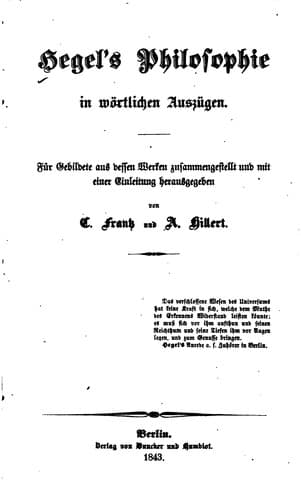
Hegel's Lectures on the History of Philosophy: Volume 3 (of 3)Hegel, Georg Wilhelm Friedrich
PhilosophyPhilosophy
Hegel's Lectures on the History of Philosophy: Volume 3 (of 3)
Hegel, Georg Wilhelm Friedrich
Philosophy -- History
Among both Catholics and Protestants his writings were held to be
heretical and atheistic, and therefore they were burned and destroyed, or
kept in concealment. His complete works are hence very seldom met with;
the greatest number of them are to be found in the University Library at
Gottingen; the fullest account of them is given in Buhle’s History of
Philosophy (_supra_, Vol. I. p. 113). His works are for the most part
rare, and in many cases interdicted; in Dresden they are still included
among prohibited writings, and are therefore not to be seen there.
Lately[70] an edition of them in the Italian language was prepared,[71]
which possibly has never yet been issued. Bruno also wrote a great deal
in Latin. Wherever he took up his abode for a time, he gave public
lectures, wrote and published works; and this increases the difficulty
of making complete acquaintance with his books. Many of his writings are
for the above reason very similar in their matter, the form only being
different, and in the evolution of his thoughts he never consequently
advanced very much nor attained to any results. But the leading
characteristic of his various writings is really to some extent the grand
enthusiasm of a noble soul, which has a sense of indwelling spirit, and
knows the unity of its own Being and all Being to be the whole life of
thought. There is something bacchantic in his way of apprehending this
deep consciousness; it overflows in becoming thus an object of thought,
and in the expression of its riches. But it is only in knowledge that
spirit can bring itself forth as a whole; when it has not yet attained
to this point of scientific culture, it reaches out after all forms,
without bringing them first into due order. Bruno displays just such an
unregulated and multiform profusion; and on that account his expositions
have frequently a dreamy, confused, allegorical appearance of mystical
enthusiasm. Many of his writings are in verse, and much that is fantastic
finds a place in them, as for instance when he says in one of his works,
entitled _La Bestia Trionfante_, that something else must be put in
place of the stars.[72] He sacrificed his personal welfare to the great
enthusiasm which filled him, and which left him no peace. It is easy to
say that he was “a restless being, who could get on with nobody.” But
whence did this restlessness come to him? What he could not get on with
was the finite, the evil, the ignoble. Thence arose his restlessness.
He rose to the one universal substantiality by putting an end to this
separation of self-consciousness and nature, whereby both alike are
degraded. God was in self-consciousness, it was admitted, but externally,
and as remaining something different from self-consciousness, another
reality; while Nature was made by God, being His creature, not an image
of Him. The goodness of God displayed itself only in final causes, finite
ends, as when it is said: “Bees make honey for man’s food; the cork tree
Public-domain text, read in full here on John Shaqi.
Reviews
Reviews
No reviews yet
Be the first to share your thoughts on this work.
Elsewhere in the archive
Join the Discussion
Join the discussion
Sign in to leave a comment or review.
Sign InorCreate an account