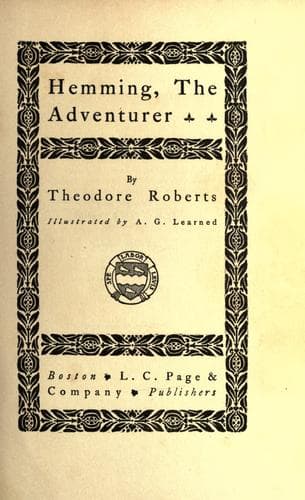
Hemming, the adventurerRoberts, Theodore Goodridge
General
Hemming, the adventurer
Roberts, Theodore Goodridge
Canadian fiction -- 20th century
Hemming sniffed the wind, and decided to go for a walk. He circled
the square three times. Then he struck up Fifth Avenue, with his
hands in the pockets of his mackintosh and his stick under his arm.
The big old houses on each side of the avenue wore an air of kindness
that was not for him. Lights were in the upper windows of most of
them. One was still awake, and carriages waited in a solemn row at
the curb. It seemed to Hemming that all the world but himself was at
peace. The coachmen and footmen waited contentedly outside, while
their masters and mistresses laughed and danced within. What had
these people to do with the bitterness of the unattainable? His eyes
were turned in upon his own heart, and nothing seemed real but this
new restlessness, this nameless desire like a crying in the dark. It
was not for fame, nor altogether for the power of expression, though
that, at one time or another, will tear the heart of every artist.
It was not bred of any regret for the past, nor inspired by
apprehension for the future. On the fly-leaf of a friend's book he
had once read the words, "There is only the eternal now--an oasis of
fleeting actuality between two deserts of mirage." Now he remembered
the words as he strolled up Fifth Avenue. The Eternal Now! Could it
give him no more solace than this? For him would it be always this
empty room, from the windows of which he might look backward upon one
mirage and forward to another? He felt in his pockets for something
to smoke. They were empty, so he decided to keep on until he could
find a tobacconist's establishment. Deep in thought, buffeted and
yet soothed by the bleak wind, he strode along, with little heed to
his course. Presently, upon glancing up, he found himself on a side
street, before the area railings of a basement restaurant that he
knew well. Here he could get a Porto Rican cigar to which he was
particularly partial, or cigarettes of pungent tobacco rolled in
sweet brown paper. He opened the iron gate, descended the steps, and
rang the signal of the initiated on the bell. The Italian woman
opened the door, and smilingly admitted him. In the larger of the
two dining-rooms only one table was occupied, for stray customers
were not welcomed after the regular dinner hours. At the table sat
two men whom Hemming knew, and one who was a stranger to him. They
were drinking coffee and smoking, and from a chafing-dish in the
centre of the table drifted an odour with a tang to it.
Upon Hemming's entrance, Potts, assistant editor of a ten-cent
magazine, called to him to join them. The Englishman did so, gladly.
Akerly, the illustrator, he knew, and he was introduced to the third,
a thick-shouldered, blond-haired youth, by name Tarmont. Tarmont
also proved to be an artist. He was a Canadian by birth, and had
just arrived in New York from a two years' visit in England.
Public-domain text, read in full here on John Shaqi.
Reviews
Reviews
No reviews yet
Be the first to share your thoughts on this work.
Elsewhere in the archive
Join the Discussion
Join the discussion
Sign in to leave a comment or review.
Sign InorCreate an account