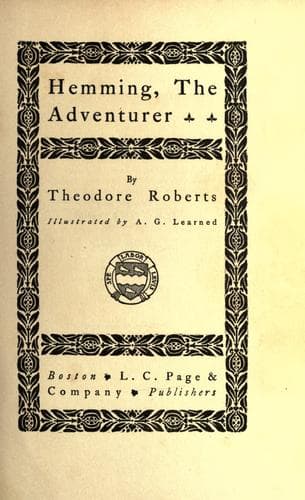
Hemming, the adventurerRoberts, Theodore Goodridge
General
Hemming, the adventurer
Roberts, Theodore Goodridge
Canadian fiction -- 20th century
Helen was pleased, though surprised, at seeing him so early. She
received him in the morning-room, which was delightfully informal.
He asked her to ride with him at four o'clock, and spoke as if this
was his reason for calling. But she thought not. Presently she
caught sight of the neat lettering on the otherwise spotless cuff,
and without so much as "by your leave" took hold of his wrist, pushed
back his coat-sleeve, and read the quatrain.
"My dear boy," she said, "it is fine. And I was just beginning to
fear that this old town had made you stupid, or--or that my
companionship makes you dull. I wondered if, after all, I was not
inspiring."
"You not inspiring!" exclaimed O'Rourke. "Why, I have had to smother
more inspirations during the last few weeks than I ever had before in
all my life. There's more inspiration in one of your eyelashes than
in all the hair on all the heads of all the other people in the
world."
"Silly," she said.
O'Rourke did not retort in words.
"But why did you smother the inspirations, you boy?" she asked,
presently.
"I can't tell you now," he replied. "But at four o'clock I'll
confess all. You want the red mare, I suppose. I'm off now to see
your pater. Wish me luck, little girl."
Helen smiled.
"I hope you don't let all your cats out of their bags as easily as
that," she said. "But it will save you the trouble of making
confession later. Yes, the red mare, please. And, dear boy, I'll
have a little talk with father at lunch, and he will never make you
smother your dear inspirations again. There, that will do. Now run
away and beard the lion. Really, you behave as if you were afraid of
never finding me again."
"Oh, I've made sure of you this time," he said. Then he remembered
the seven verses, and, pulling them from his pocket, read them aloud.
The fire in the morning-room was wonderfully cheerful. The clock
clicked softly, and chimed once or twice, unheeded. They talked a
great deal, and made plans for the future, and O'Rourke smoked a
cigarette. When Mr. Hudson came home to his lunch, he found them
still engaged in conversation beside the morning-room fire. They
looked guiltily at the clock. O'Rourke bowed to Mr. Hudson, and
extended his hand.
"I have decided, sir, to stick to scribbling," said he.
[Illustration: "'I HAVE DECIDED, SIR, TO STICK TO SCRIBBLING'"]
"Did you ever think of not sticking to it?" she asked. O'Rourke
gazed straight ahead, and had the grace to blush. A truthful woman
can always--well, act--with more ease than a truthful man.
"I am not fit for anything else," he said.
"Dear me, dear me," said Hudson, glancing nervously at his daughter.
"I haven't a doubt that you are right, Bertram. A man should be the
best judge himself of what he is good for."
"And now," said the lady, "you may stay to lunch. But you must hurry
away right afterward for the horses."
Public-domain text, read in full here on John Shaqi.
Reviews
Reviews
No reviews yet
Be the first to share your thoughts on this work.
Elsewhere in the archive
Join the Discussion
Join the discussion
Sign in to leave a comment or review.
Sign InorCreate an account