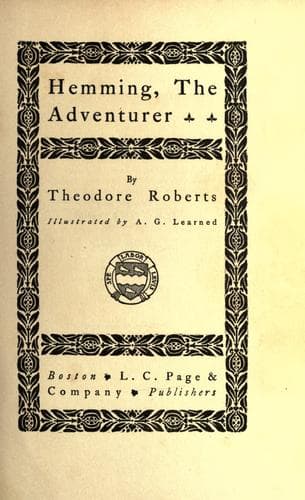
Hemming, the adventurerRoberts, Theodore Goodridge
General
Hemming, the adventurer
Roberts, Theodore Goodridge
Canadian fiction -- 20th century
Mr. Pollin braced himself, and swallowed hard. "My dear," he said,
"I want to confess that I promised your mother that I would speak to
you about--about--"
"About what, uncle?" She breathed fast, and her face was anxious.
"Dash it all, about some silly rot!" cried the old gentleman, "and,
by gad, I don't intend to mention it. You are quite old enough to
look after your own affairs,--of that nature,--and you are much wiser
than the people who wish to look after them for you."
"I know what it is," said Molly, slowly.
"Then don't give it another thought," said Mr. Pollin. He patted her
hand gently, and sighed with relief. "Now we can have a cigarette,"
he said. But his real task was yet to come. He wanted to know, by
her own showing, if she still cared for Hemming. How the devil was
it to be done, he wondered. He looked at the clock, and saw that the
general was not due inside another forty minutes. He looked at
Molly. She leaned back in his deepest chair, looking blissfully at
home and uncommonly pretty. Her slight, rounded figure was turned
sidewise between the padded arms of the chair, while her grave gaze
explored the book-shelves. Between two fingers of her right hand she
held a fat cigarette, unlighted.
"What a lucky man an uncle is," he murmured.
She wrinkled her eyes at him for a moment, and then laughed softly.
"That was very prettily said; but I would much rather you read to
me--something that you are very fond of. I'll see if I like it.
Perhaps our tastes are a good deal the same, and, if so, you will be
able to save me a lot of time and temper by telling me what to read."
"A literary adviser," suggested Mr. Pollin, as he fumbled through a
stack of magazines and papers beside his chair.
"Surely you will not find anything in the magazines," she exclaimed.
In answer, he selected one from the heap, and opened it at a marked
page.
"What is it?" she asked.
"'Pedro, the Fisherman,' is the name of it," he replied, and
straightway began to read.
It was a simple story of a small, brown boy somewhere at the other
side of the world, and yet the beauty, the humble joy, and the humble
pathos, made of it a masterpiece,--for the seeing ones. Pollin read
it well, with sympathy in his voice and manner, but with no
extravagance of expression. When he came to the end (it was a very
short story), he got up hurriedly and placed the magazine in his
niece's lap.
"I must see how Scanlan is getting along," he said, and left the room.
Public-domain text, read in full here on John Shaqi.
Reviews
Reviews
No reviews yet
Be the first to share your thoughts on this work.
Elsewhere in the archive
Join the Discussion
Join the discussion
Sign in to leave a comment or review.
Sign InorCreate an account