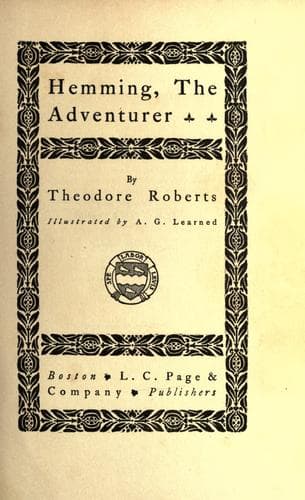
Hemming, the adventurerRoberts, Theodore Goodridge
General
Hemming, the adventurer
Roberts, Theodore Goodridge
Canadian fiction -- 20th century
O'Rourke's affairs went along merrily. He wrote and sold stories and
poems. His name began to appear each month on the cover of a certain
widely read magazine. Everything was in line for an early wedding
and a career of happiness "for ever after."
One morning, while O'Rourke was hard at work, Hemming, who had gone
out immediately after breakfast, returned to their sitting-room and
laid a red leather case on his friend's manuscript. O'Rourke
completed a flowing sentence, and then straightened up and opened the
case. A very fine brier-root pipe was disclosed to his view.
"Where did you steal this?" he inquired.
"It is a present for you," said Hemming, dropping into a chair.
O'Rourke put down his pen, and eyed his friend with an air of
surprise.
"A present!" he exclaimed. "Why, my dear chap, surely I've been
taking anything of yours that I happened to want long enough for you
to see that there is no need of this depressing formality."
"But we've been such chums."
"You haven't just found that out, I hope."
Hemming shook his head.
"I'm going away," he explained, "and I suppose it will be without you
this time."
"I wouldn't mind going to Staten Island," replied O'Rourke, "but for
any farther than that you will have to mark me out."
"I sail for England to-morrow," Hemming informed him.
"Have you been--have you received a letter, or anything of that
kind?" inquired his comrade.
"No, but Stanley told me I was a fool not to go back."
"Could have told you that myself."
"Then why didn't you?"
"Thought you knew it."
"I didn't know it,--and I am not sure, even now," retorted Hemming.
"Well, old man," rejoined O'Rourke, "you know her better than I do,
so suit yourself. But my advice is the same as Stanley's."
He stared moodily at the Englishman. In fact, he was already lonely
for his energetic, steel-true roommate. What days and nights they
had seen together! What adventures they had sped, knee to knee!
What vigils they had kept by the camp-fires and under the
cabin-lamps! And now a girl!--but at that thought his brow cleared.
"I think we have both done with the old pace," he remarked, pensively.
"I wonder," said Hemming.
That night about a dozen men gathered in Tarmont's studio. Hemming
was the guest of honour. The big room was soon filled with smoke.
There were many things to drink and a few things to eat. Songs were
sung, and stories told. Hemming tried to make a speech, and O'Rourke
had to finish it for him. After that, Tarmont suggested leap-frog.
"Just wait until I do my little stunt," begged Potts. He tuned his
banjo, and, to an accompaniment of his own composing, sang the
following verses:
"'You may light your lamps to cheer me,
You may tune your harps for me,
But my heart is with my shipmates
Where the lights are on the sea.
"'You may wine me, you may dine me,
You may pledge me to the brim,
But my heart is pledging Charlie,
And you have no thought of him.
Public-domain text, read in full here on John Shaqi.
Reviews
Reviews
No reviews yet
Be the first to share your thoughts on this work.
Elsewhere in the archive
Join the Discussion
Join the discussion
Sign in to leave a comment or review.
Sign InorCreate an account