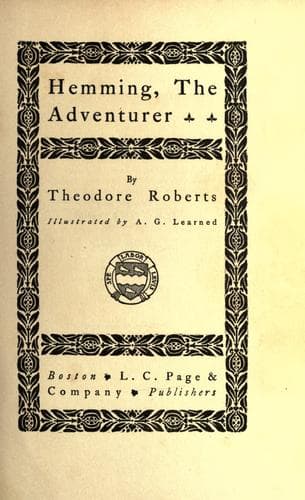
Hemming, the adventurerRoberts, Theodore Goodridge
General
Hemming, the adventurer
Roberts, Theodore Goodridge
Canadian fiction -- 20th century
Mr. Cuddlehead did not go far afield during the day following his
glimpse of the officers' dinner-table. Instead, he kept to his room
until evening, or at most took a furtive turn or two on the cobbles
before the inn door. After his lonely and not very palatable dinner
was over, he set out cautiously for the President's villa. He wanted
to have a talk with Miss Tetson alone. She, no doubt, could explain
matters to him, so that he might be able to decide on a course of
action. He walked slowly, keeping always a vigilant look-out for the
trim, dauntless figure of Herbert Hemming. At the great gateway the
brown boy on sentry-go saluted, and let him pass without question.
In return he treated the fellow to his blandest smile and a _milreis_
note. He did not keep long to the drive, but turned off into a
narrow path as soon as he felt that the soldier had ceased watching
him. He took his time, traversing winding paths between low tropical
shrubs and yellow-stemmed bamboo, but always drawing nearer to the
quiet mansion. Presently his ear caught a welcome sound,--the soft,
frivolous strumming of a banjo. He was aware that Hemming was not
musical; in fact, he remembered that his rendering of "Father
O'Flynn" had once been mistaken for the national anthem.
Cuddlehead found Miss Tetson on a stone seat, near her favourite
fountain. At sight of him, she stopped her idle playing, and
answered his salutation with the coldest of bows. Her lover's kisses
still burned on her lips, and words of his impulsive wooing still
rang sweetly in her ears. Even the little brown crane, that stood
there watching the sparkling water with eyes like yellow jewels,
reminded her of a certain evening when she had been unkind to
Valentine Hicks. The hour was not for Cuddlehead.
Undisturbed by the coolness of his reception, Mr. Cuddlehead seated
himself at the far end of the bench, and began to talk. He described
his journey from Pernambuco to Pernamba, and with so fine a wit that
Marion smiled. He told little anecdotes of his past, very clever,
and very vague as to dates and scenes. The girl almost forgot the
sinister aspect of his face in the charm of his conversation, and
when he mentioned Hemming, in terms of warmest respect, she confided
to him something of his trouble with the army.
"Perhaps I can be of some use; one Englishman should be good for ten
of those niggers," he said. He lifted the banjo from the seat, and
made it dance and sing through the newest Southern melody. His touch
was both dainty and brilliant. He replaced the instrument on the
seat between them. He saw that the girl was more favourably
impressed with him than she had been. For a little while they kept
silence, and her thoughts returned to Valentine Hicks. Suddenly they
heard Hemming's voice, pitched low and sharp, in anger. He was
hidden from them by shrubs of tangled growth.
"I have given my orders," he said. "Do you understand?"
Public-domain text, read in full here on John Shaqi.
Reviews
Reviews
No reviews yet
Be the first to share your thoughts on this work.
Elsewhere in the archive
Join the Discussion
Join the discussion
Sign in to leave a comment or review.
Sign InorCreate an account