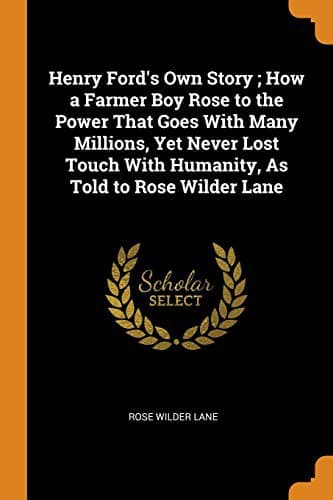
Henry Ford's Own Story: How a Farmer Boy Rose to the Power that goes with Many Millions, Yet Never Lost Touch with HumanityLane, Rose Wilder
Philosophy
Henry Ford's Own Story: How a Farmer Boy Rose to the Power that goes with Many Millions, Yet Never Lost Touch with Humanity
Lane, Rose Wilder
Automobile industry and trade -- United States -- History; Businesspeople -- United States -- Biography; Ford, Henry, 1863-1947
Ford wanted his new plan known; he wanted employers everywhere to see
what he was doing, how he did it, and what the effects would be. He did
expect the factory to run better, to produce more cars. If it had not
done so his plan would have been a failure.
"Do the thing that is best for everybody and it will be best for you in
the end." That was his creed. He hoped to prove its truth so that no one
would doubt it.
Nor is Ford a philanthropist, with the ordinary implications that follow
that word. He is a hard-headed, practical man, who has made a success in
invention, in organization, in the building of a great business. His
contribution to the world is a practical contribution. His message is a
practical message.
"This whole world is like a machine--every part is as important as every
other part. We should all work together, not against each other.
Anything that is good for all the parts of the machine is good for each
one of them.
"Or look at it as a human body. The welfare of one part is dependent on
all the other parts. Once in a while a little group of cells get
together and takes to growing on its own account, not paying any
attention to the rest. That is a cancer. In the end what it takes from
the rest of the body causes the death of the whole organism. What do
those independent, selfish cells get out of it?
"I tell you, selfishness, trying to get ahead of the other fellow,
trying to take away from other people, is the worst policy a man can
follow. It is not a 'practical' viewpoint on life. Any man who is a
success is a success because his work has helped other men, whether he
realizes it or not. The more he helps other men the more successful
every one will be, and he will get his share."
Putting his profit-sharing plan into effect was not a simple matter of
writing the checks. He had to educate not only other employers, but his
own men as well. They must be taught the proper way to use money, so
that it would not be a detriment to themselves or a menace to society in
general.
On the other hand, Ford did not believe in the factory systems in use
abroad. He did not mean to give each of his workmen a model cottage,
with a model flower garden in front and a model laundry in the rear, and
say to them: "Look at the flowers, but do not pick them; it will spoil
my landscape effect. Look at the lawn, but do not cut it; I have workmen
for that."
He meant to place no restraints on the personal liberty of the men. He
believed that every man, if given the opportunity, would make himself a
good, substantial citizen, industrious, thrifty and helpful to others.
He meant his plan to prove that theory also.
Public-domain text, read in full here on John Shaqi.
Reviews
Reviews
No reviews yet
Be the first to share your thoughts on this work.
Elsewhere in the archive
Join the Discussion
Join the discussion
Sign in to leave a comment or review.
Sign InorCreate an account